How I Rebuilt ERP as a True Operating System
There is a moment in every industry where you realize the true enemy is not complexity, it is incoherence.
Systems do not collapse because there is too much to manage. They collapse because nothing connects. Complexity is survivable. Incoherence is fatal.
And incoherence is expensive. It slows decisions. It erodes trust. It fractures teams. It places a ceiling on what a company can become.
Across my career at Ntractive, Gro CRM, Norhart, Taxa, and Aiwyn, we spent more than a decade rebuilding coherence inside organizations, creating CRM OS, ERP OS, Interface OS, and AI-native operating engines that helped secure over $113M in funding and transformed how companies move.
One principle has guided all of this work:
You do not fix enterprise systems by adding features. You fix them by redesigning the way truth moves through an organization.
This philosophy has become my operating system for designing teams, platforms, and products that scale with elegance and velocity.
Why does ERP quietly fail?
ERP did not fail loudly. It failed the way erosion works, slowly, invisibly, until the structural integrity is gone.
It became a ledger with a UI. A system that recorded transactions but never revealed truth. An operating system does the opposite. It makes state legible to everything running on top of it.
You saw the symptoms everywhere:
- Teams building spreadsheets just to survive the week
- Operators creating undocumented workflows to protect themselves
- Leaders drowning in reconciliation meetings
- Departments running parallel universes of real process vs system process
Everything was "synced." Which is another way of saying nothing was.
The emotional collapse. People stopped trusting the system. And once that happens, momentum dies.
ERP did not need a new module. It needed a new purpose.
What did ERP OS do differently?
ERP OS redefined the relationship between humans, work, and information. It delivered:
- A 40 to 60 percent reduction in operational friction, because the system collapsed the distance between intention and action.
- Dramatically reduced training time, because it aligned with human cognition, not technical structure.
- Predictive intelligence instead of reactive chaos, surfacing bottlenecks, risks, and imbalances before they materialized.
- A living operational narrative, showing not just what was happening, but why, and what would happen next.
ERP OS did not just improve performance. It restored trust.
The moment everything shifted
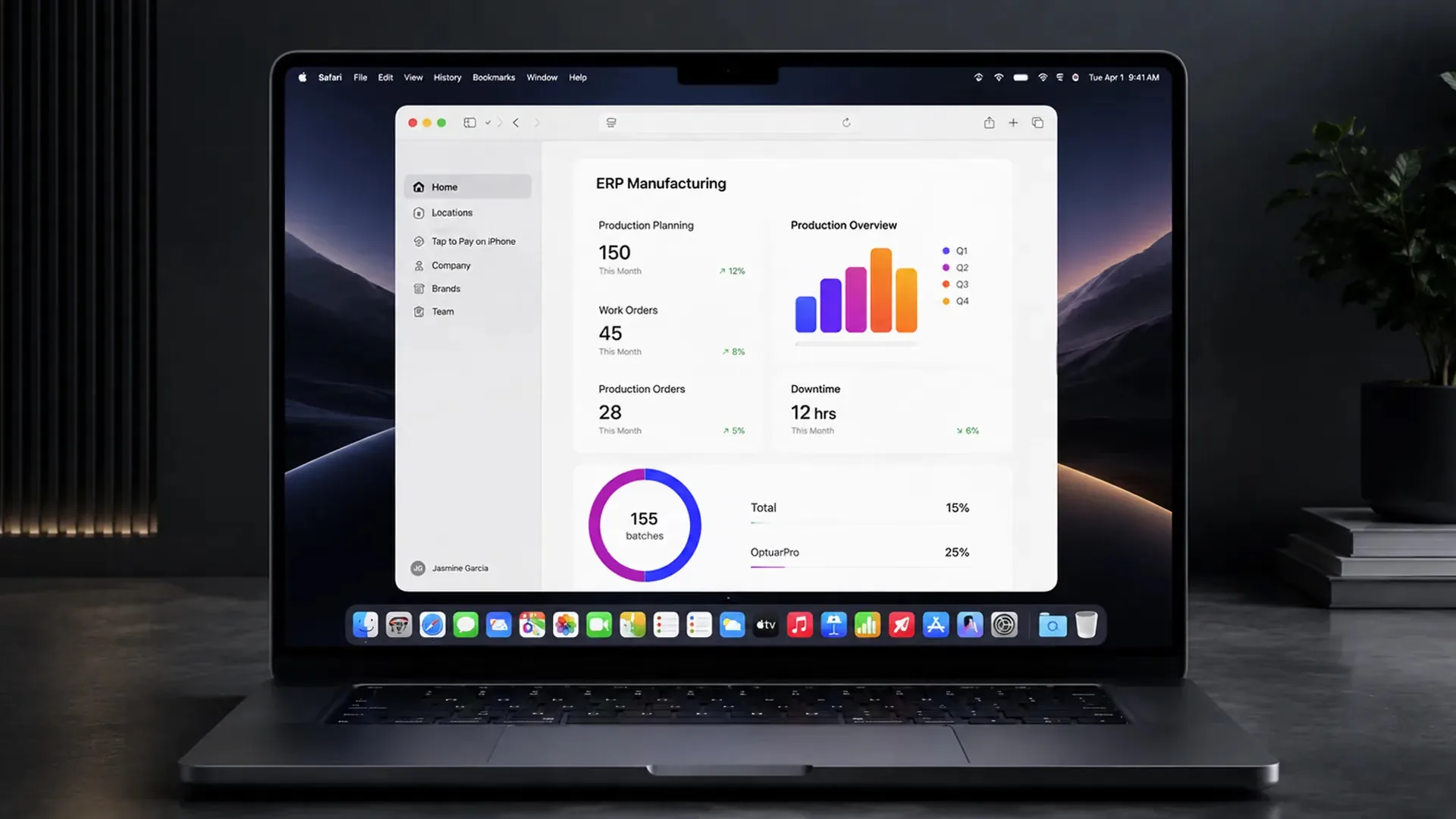
In one of our earliest deployments inside a manufacturing operation, teams had spent a decade constructing a shadow ecosystem of spreadsheets, notes, and hallway conversations. The real workflow lived everywhere except inside the ERP.
When ERP OS went live, everything reorganized into a single, fluid narrative. Work orders to materials to machine telemetry to capacity to forecasting to risk. All on one seamless timeline.
A supervisor stepped forward, stared for several seconds, and finally said:
This is the first time I have ever seen our work as one thing.
That was the moment. Not because the software worked. But because the company finally saw itself.
Truth creates trust. Trust creates speed. Speed creates possibility.
Eight industries. One truth layer.
ERP OS was built as a foundational operating system, one that adapts to each industry while preserving absolute design purity.
Manufacturing
Unified work orders, materials, machines, and maintenance formed a living operational heartbeat.
Outcome: bottlenecks surfaced early, throughput increased, with double-digit gains in on-time completion.
HealthTech
Compliance became part of the patient journey instead of an external obligation.
Outcome: lower administrative friction, trusted audit trails, and more human-centered care.
PropTech
Portfolio operations, vendors, maintenance intelligence, and financial flows existed in one semantic graph.
Outcome: proactive operations replaced reactive cycles.
MedTech
Expiration tracking, lot traceability, regulated sequencing, and device workflows aligned into a single truth layer.
Outcome: audit-ready precision and operational calm.
Retail
Forecasting, inventory, merchandising, and execution connected demand signals to execution in one motion.
Outcome: fewer stockouts, smarter adjustments, and more resilient stores.
Construction
Plans, budgets, schedules, and subcontractors finally revealed dependency chains rather than hiding them.
Outcome: clearer risk visibility, fewer surprises, and tighter project outcomes.
Field Services
SLAs, technicians, routes, parts, and expectations synchronized into a predictable operational rhythm.
Outcome: more on-time completions and a calmer field team.
Professional Services
Time, billing, project health, and client communication merged into one transparent system of truth.
Outcome: firms moved from dashboards to real clarity.
The architecture behind the reinvention
ERP OS was successful because it redefined the underlying architecture of enterprise work.
A Unified Temporal Model. Work was not a collection of transactions, it became a dynamic timeline of intention and consequence.
A Semantic Operational Graph. Dependencies, constraints, assets, risks, and relationships existed in a single reasoning model.
A Context-Aware Interface. The UI shifted with intent, role, and moment, showing the right clarity at the right time.
A First-Principles Approach to Design. Every interaction asked a single question: Does this make work feel inevitable?
Why this matters
Companies do not slow down because they lack features. They slow down because their systems fracture their truth.
What organizations truly need is coherence.
Operating systems that amplify intelligence, reduce cognitive load, increase trust, accelerate execution, restore agency, and reveal truth.
That is what ERP OS delivered. That is the work I love. And that is the design-led, systems-driven leadership I bring to every zero-to-one environment.
When software disappears, teams finally appear. And when teams appear, everything accelerates.
Related reading:
- How CRM OS Reimagined Eight Industries
- Trust Is the Product
- AI Roadmaps Fail When They Ship Features
Originally published on justinbartak.ai on Dec 1, 2025.
Common questions
Why do most ERP systems fail enterprises?
ERP fails through incoherence, not complexity. It becomes a ledger with a UI that records transactions but never reveals truth. Teams build shadow spreadsheets, operators create undocumented workflows, and leaders drown in reconciliation meetings. Everything looks synced, which means nothing connects. People stop trusting the system, and momentum dies.
What is an ERP operating system and how is it different from traditional ERP?
An ERP OS redefines the relationship between humans, work, and information instead of adding modules. It delivers a 40 to 60 percent reduction in operational friction, far lower training time, predictive intelligence over reactive chaos, and a living operational narrative. It shows what is happening, why, and what happens next.
How do you actually fix broken enterprise software?
You redesign how truth moves through the organization rather than adding features. Companies slow down because their systems fracture their truth. The fix is coherence: a unified temporal model, a semantic operational graph, and a context-aware interface that surfaces the right clarity at the right moment, so teams trust the system again. Read the full article
Related research
- AI-Native Development, By the Numbers Aug 2026.
Follow the work.
I write these while the Machine runs. Get the next one wherever you already read.