Orbyt Runs on Loops, Not Prompts.
Orbyt's founder describes running autonomous agent loops, not prompts, to build and maintain a 425,000-line product. This is what that system does, how it is bounded, and what it does not prove.
Key findings
- Orbyt's test suite has grown to 11,372 tests, described as accumulated institutional memory rather than a one-time artifact.
- Agent auto-healing operates against a 35-dimension audit harness; the agent does not get to redefine what counts as correct.
- Paths that guard money and access are built to fail closed, so an unhealed failure denies access rather than permitting it.
- The operator reports swapping frontier models under Orbyt twice, once by choice and once forced by export controls, without the system resetting.
- Orbyt is reported as over 425,000 lines and 11,372 tests, built solo in 32 days for about $400, and shipped daily since.
Key measurements
| Measure | Value | Source and date |
|---|---|---|
| Test suite size | 11,372 tests | Orbyt's automated test suite, as stated by the operator |
| Audit harness scope | 35-dimension audit harness | Orbyt's correctness gate, as stated by the operator |
| Codebase size | over 425,000 lines | Orbyt's repository, as stated by the operator |
| Build timeline | 32 days | Solo build of Orbyt, as stated by the operator |
| Build cost | about $400 | Solo build of Orbyt, as stated by the operator |
| Frontier model swaps | twice | Orbyt's operating history, as stated by the operator |
The thesis.
Justin Bartak's claim is that building Orbyt stopped being a prompting activity and became a systems activity. He does not type the product into existence. He runs loops: autonomous agents that take a spec, build the feature and its tests, run the checks, repair their own failures, and write what they learned back into the repo. His stated role moved up a level, to designing the machine and judging its output rather than typing instructions and correcting them one at a time.
What was found.
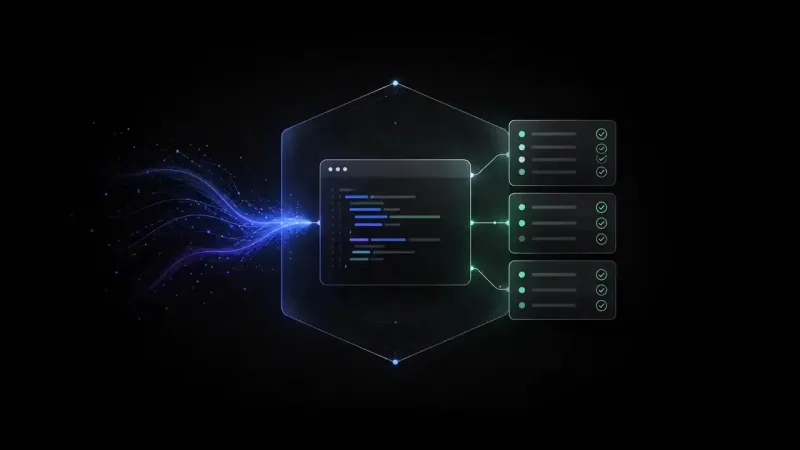
One loop, as described, runs end to end without the operator typing intermediate instructions. An agent picks up a spec that defines what done means, which paths must fail closed, and what is out of scope. It reads the repo for context, including docs, conventions, and what previous loops left behind. It builds the feature and the tests together, in Claude Code. It runs the checks. On a red result, it reads the failure, fixes its own work, and reruns until green. Only then does the operator review the outcome, not the keystrokes. Multiple loops run in parallel, each in its own terminal, none waiting on the operator to type the next instruction.
Auto-healing is the mechanism by which the loop repairs its own failures. A red test, a type error, or a broken build feeds back to the agent, which diagnoses, fixes, and reruns. The article states most failures never reach the operator, who instead finds out they existed by reading the log. This healing is bounded: it happens against a fixed definition of correct, encoded as 11,372 tests and a 35-dimension audit harness, and the agent does not get to redefine what correct means. Paths that guard money and access are built to fail closed, so an unhealed failure denies rather than permits.
The loop is described as learning through write-back. Every finished loop is said to leave the repo smarter than it found it: updated docs, a new convention, a sharper rule, and new tests. The article states that this is why the learning survives a change of underlying model. Bartak reports swapping frontier models under Orbyt twice, once by choice and once forced by export controls, and states nothing reset because nothing important lived in the model.
The operator's remaining role is described as four things: intent (what gets built and why), taste (choosing among agent-generated options), the bar (defining and holding what green means), and review (reading outcomes fast enough to keep pace).
The evidence.
This is a first-person account by the operator of the system he built, not an independent audit or a third-party benchmark. The evidence offered in the source consists of: a description of the loop's mechanics (spec to build to test to heal to green to review), the existence of a 35-dimension audit harness and fail-closed paths on sensitive functions, the anecdote of two model swaps completed without reported reset, and a set of scale figures for the resulting product: over 425,000 lines, 11,372 tests, built solo in 32 days for about $400, shipped daily since. No external verification, benchmark comparison, or third-party review of these figures or of the harness is cited.
How it was done.
See methodology.
What it implies.
If the described pattern holds, the engineering work shifts from writing implementation to writing specs as checks, building real feedback signals (tests, types, the build) that run on every attempt, and defining which paths must fail closed. The test suite functions less as a one-time artifact and more as an accumulating record of every mistake a loop has made and fixed. Because the write-back targets the repo rather than a model's context or weights, the system's memory is portable across model swaps, which the article treats as a structural property of the design rather than a claim about any particular model's capability.
What it does not establish.
See limitations.
Methodology
Per the source, an agent is given a spec that defines what done means, which paths must fail closed, and what is out of scope. It reads the repo for context (docs, conventions, prior loop history), then builds the feature and its tests together in Claude Code. It runs the checks; on failure it reads the error, fixes its own work, and reruns until the checks pass. Multiple such loops run concurrently in separate terminals. The operator does not review intermediate steps, only the finished outcome. When a loop finishes, it writes back updated docs, conventions, rules, and new tests into the repo, which is presented as the mechanism by which the system accumulates knowledge across loops and across model changes. The source does not describe any measurement protocol, sampling method, or independent check on these claims beyond the operator's own account.
Limitations
This is a first-person description by Orbyt's founder of a system he built and operates; it is not an independent audit, a controlled study, or a third-party benchmark. The article does not state a failure rate, a healing success rate, or how many loops fail to reach green without human intervention; the claim that 'most failures never reach me at all' is asserted without a supporting figure. There is no baseline comparison to traditional development, no data on defect rates in shipped code, and no breakdown of what the 'about $400' cost or the '32 days' timeline include. The 35-dimension audit harness and the fail-closed guarantees on money and access paths are described but not independently verified in the source. The two reported model swaps are described as not requiring a reset, but no verification detail or measurement accompanies that claim. Because this describes one operator building one product, it does not establish how the approach generalizes to teams, to other codebases, or to domains with different risk profiles.
Sources
Common questions
What is loop engineering in the context of Orbyt?
Loop engineering is Bartak's term for running autonomous agents that take a spec defining what done means, build a feature and its tests, run checks, and repair their own failures until the result is green. The operator reviews the outcome rather than typing intermediate instructions. Multiple loops can run in parallel, each in its own terminal, without the operator directing each step.
How does auto-healing work in Orbyt's development process?
Auto-healing is how a loop repairs its own failures. A red test, a type error, or a broken build feeds back to the agent, which diagnoses the problem, fixes it, and reruns the checks. Most failures never reach the operator, who instead learns they existed by reading the log. Paths guarding money and access are built to fail closed if unhealed.
What happens to Orbyt's automated learning when the underlying AI model changes?
According to Bartak, nothing resets when the model changes, because the loop writes what it learns back into the repo itself, as updated docs, new conventions, sharper rules, and new tests, rather than into the model. He reports swapping frontier models twice, once by choice and once forced by export controls, with no reported loss of progress.
What is left for the human operator to do if agents build the software?
The operator's remaining role covers four things: intent, meaning what gets built and why, taste, meaning choosing among agent-generated options, the bar, meaning defining and holding what counts as green, and review, meaning reading outcomes fast enough to keep pace with the loops.
Related research
Follow the work.
I write these while the Machine runs. Get the next one wherever you already read.