The Prompt Is Dead. Long Live the Loop.
Prompt engineering is dead because the prompt stopped being the unit of work. The unit of work is now the loop: an agent that plans, acts, gets feedback, corrects, and repeats until a verification gate says done. Loop engineering is the discipline of building that machine. The prompt did not disappear. It got demoted to one turn inside it.
A prompt is a wish. A loop is a machine that grinds toward correct.
What killed prompt engineering?
In 2023, prompt engineer was the hottest job in tech, with listings up to $200,000 for people who could whisper to a model. IEEE Spectrum called the discipline dead in early 2024, after research showed that models optimize prompts better than human engineers do. By 2025 the obituary was mainstream: the Wall Street Journal pronounced the hottest AI job of 2023 already obsolete.
Two things killed it. First, models got better at inferring intent, so the clever incantation stopped paying. Second, and this is the part most companies still miss, the work moved. One perfect prompt gets you one good answer. Products are not made of answers. They are made of thousands of correct actions in a row, and no wording buys you that.
The skill did not vanish. It dissolved into something bigger.
What is AI loop engineering?
AI loop engineering is designing the system the model runs inside, so that a fallible model produces reliable work. Anthropic defines agents as LLMs using tools based on environmental feedback in a loop: gather context, take action, verify the work, repeat. The engineering is not in the asking. It is in the machine around the asking.
The industry already took one step in this direction. Andrej Karpathy endorsed context engineering over prompt engineering, calling it the delicate art and science of filling the context window with just the right information for the next step. He is right, and it is still only one component. Context decides what the model sees. The loop decides what survives.
Context engineering feeds the model. Loop engineering governs it.
What are the five parts of an engineered loop?
Every loop I run has the same anatomy.
The spec. What done means, written down before the first token. On Orbyt, the spec lives in project docs and rules files the agent reads on every run. A vague spec produces a confident wrong loop, so this is where the leverage starts.
The context. The repo is the context: the docs, the project log, the conventions, the tests. The agent does not start from a blank chat. It starts from everything the last thousand loops learned.
The action. The tools the agent can use: edit files, run commands, execute tests. An agent that can only talk is a chatbot. An agent that can act is a worker.
The signal. Tests, type checks, and builds that score every attempt in seconds. This is the part most teams skip, and it is the part that makes the loop converge instead of spiral. A failing test is feedback that arrives in seconds instead of a sprint.
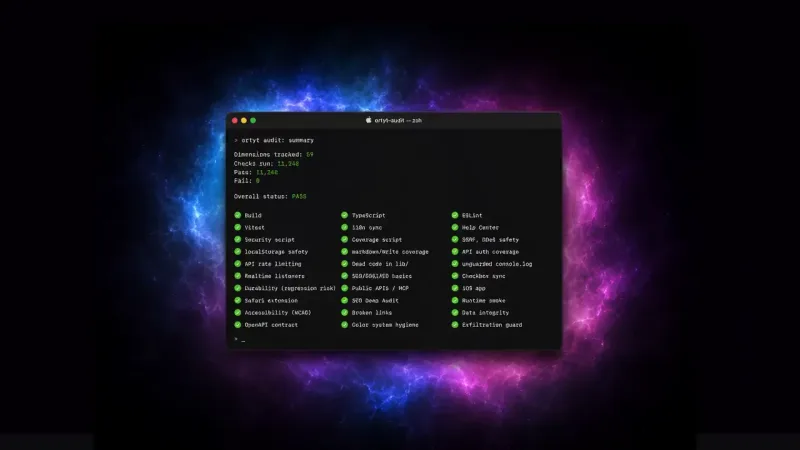
The gate. The verdict that decides shipping. On Orbyt that is a 35-dimension audit harness and 11,372 tests, and the critical paths fail closed. The loop does not end when the model says done. It ends when the gate is green.
There is a sixth element that makes the whole thing compound: the write-back. What a loop learns lands in the repo as docs, tests, and rules. The next loop starts smarter. That is the difference between using AI and accumulating it.
| Prompt era | Loop era | |
|---|---|---|
| Unit of work | The prompt | The loop |
| Core skill | Wording | System design |
| Output | An answer | A verified change |
| Failure mode | Bad answer, caught by a human | Red check, retried by the machine |
| Quality ceiling | The model's first try | The gate's standard |
| Survives a model swap | No, folklore resets | Yes, the loop holds |
Why does the loop beat the prompt?
Because the loop converges and the prompt cannot. A prompt's output is capped by the model's first attempt. A loop with a real feedback signal grinds toward correct even when individual turns are mediocre, because wrongness surfaces in seconds and gets fed back. You are no longer betting on a great answer. You are running a process whose exit condition is proof.
The loop is also honest in a way the prompt never was. A prompt fails silently, as a confident wrong answer that reads beautifully. A loop fails loudly, as a red gate. I would rather have a loud failure in my terminal than a quiet one in production.
And the loop is model-agnostic infrastructure, while prompts are model-specific folklore. I swapped the frontier model under Orbyt twice in one stretch, once by choice and once when export controls forced it, and shipping never stopped. The spec, the signal, and the gate held the standard. The wording never had to, because the wording was never where the quality lived. Drop a better model into the same loop and the whole system levels up overnight. Move a prompt library to a new model and you start re-learning folklore.
I build with Claude Code all day, and the honest description of my job is not prompting. It is maintaining the loop: sharpening specs, tightening signals, raising the gate. The bottleneck was never the code, and it was never the phrasing either.
What should a leader do about this?
Stop funding prompt craft as AI strategy. The prompt workshop, the prompt library, the prompt template wiki: that is 2023 spend on a 2026 problem. The teams getting compounding returns from AI are not the ones with the best wording. They are the ones with the best machinery around the model.
Ask one question of every AI initiative you own: when the model is wrong, what tells us, and how fast? If the answer is a person notices, you do not have a loop. You have a prompt with expensive supervision, and it will not scale past a demo.
Then build the loop in order. Spec first: write down what done means, in checks, not prose. Signal second: make the tests the spec so every attempt gets scored in seconds. Gate third: one command, one verdict, fail closed. The wording of your prompts will matter less every quarter. The quality of your loop will matter more.
Companies that engineered prompts got demos. Companies that engineer loops get products.
See it in practice: Orbyt, built and run solo, the first product out of Purecraft.
Related reading:
- Verification Is the New Literacy the gate at the end of every loop, and why reading the verdict replaced reading the code
- No Harness, No Trust. the feedback signal and the gate, built as one system
- I Manage AI Agents Now, Not People the operator's seat above a fleet of running loops
- I Run a Stack of Terminals. The Bottleneck Was Never the Code. what a day of loop engineering actually looks like
- Your Tests Are the Spec Now. the spec, written as checks the loop can obey
- Loop Engineering: How Orbyt Builds Itself this discipline, shown as the working system behind Orbyt
- Long Horizon Agents Don't Fail. They Pass. what happens over six months when the gate stays green and the loop is wrong anyway
Originally published on justinbartak.ai on Jul 21, 2026.
Common questions
What is AI loop engineering?
AI loop engineering is the discipline of building the system a model runs inside: the spec that defines done, the context the model sees, the actions it can take, the feedback signal that scores every attempt, and the verification gate that decides what ships. The loop repeats until the gate is green. The prompt is one turn inside it.
Is prompt engineering really dead?
As a job, yes. IEEE Spectrum called it dead in 2024 and the six-figure listings are gone. As a skill, it got absorbed. Clear instructions still matter, but they stopped being the leverage point. Wording buys you a better single answer. Products need thousands of correct actions in a row, and only a loop delivers that.
How is loop engineering different from context engineering?
Context engineering, the term Karpathy endorsed, is the art of filling the context window with the right information for the next step. It is one component. Loop engineering is the whole machine: context plus the spec, the actions, the feedback signal, and the verification gate. Context decides what the model sees. The loop decides what survives.
What are the parts of an engineered AI loop?
Five. A spec that defines done before the first token. Context that puts the right information in the window. Actions, meaning the tools the agent can use. A signal, the tests and checks that score each attempt in seconds. And a gate, the fail-closed verdict that decides shipping. What the loop learns gets written back, so the next loop starts smarter. Read the full article
Related research
Follow the work.
I write these while the Machine runs. Get the next one wherever you already read.