The Test Suite Became Orbyt's Only Living Specification.
A solo, 32-day build of a 425,000-line product left no governing prose document behind. What governs it is 11,372 tests inside a 35-dimension harness, and the founder's account of why that happened.
Key findings
- Orbyt was built solo in 32 days and is now over 425,000 lines, according to the author.
- The author reports 11,372 tests governing the codebase, with no separate prose specification maintained as source of truth.
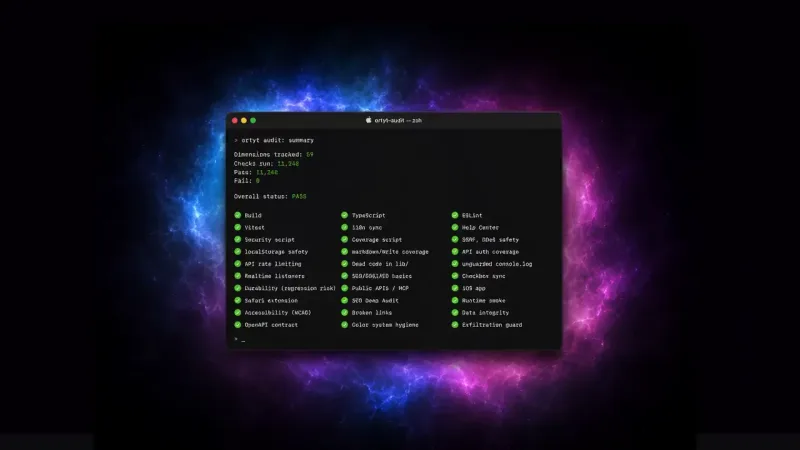
- Those tests sit inside a 35-dimension audit harness run through a single command covering build, types, lint, fifteen locales, the iOS app, the Safari extension, a security battery, and accessibility.
- The author states he switched frontier models mid-session twice in June 2026, once by choice and once due to export controls, and reports both swaps as uneventful.
- The article's fail-closed example: Orbyt's subscription gating denies access when a check breaks, rather than granting it.
Key measurements
| Measure | Value | Source and date |
|---|---|---|
| Time to build Orbyt | 32 days | Author's first-person account of building Orbyt solo |
| Size of the Orbyt codebase | over 425,000 lines | Author's first-person account |
| Number of tests governing Orbyt | 11,372 tests | Author's first-person account |
| Dimensions covered by Orbyt's audit harness | 35-dimension audit harness | Author's first-person account |
| Locales checked by the harness | fifteen locales | Author's first-person account |
| Frontier model switches mid-session | twice | 2026-06 · Author's first-person account, June 2026 |
The thesis.
When an AI agent can ship changes faster than a person can update a document, the document stops being trustworthy. The article's claim is that executable tests, not prose specs, become the artifact a codebase actually obeys, because only an executable artifact can verify itself on every commit. A spec written Monday can describe a system that no longer exists by Thursday, and nothing forces it to catch up.
What was found.
The author reports that Orbyt, built solo in 32 days, is now over 425,000 lines governed by 11,372 tests, with no prose document describing what the system is supposed to do. He states there is no separate specification he maintains as source of truth. The tests sit inside what he calls a 35-dimension audit harness, run through a single command that checks build, types, lint, fifteen locales, the iOS app, the Safari extension, a security battery, and accessibility. He states that production readiness is decided by whether that harness passes, not by whether a model reports a task as done.
He also reports switching frontier models mid-session twice in June 2026, once by choice and once because of export controls, and states both swaps were uneventful because the test suite held the contract rather than the model.
The evidence, as stated.
The evidence offered is a first-person account of one project. The author asserts, without citing external data, that a prose spec is a description of intent while a test is a description of behavior that fails when the system stops matching it. He asserts that high line-coverage numbers on the wrong paths are theater, and that the real measure is whether every path an organization cannot afford to break has a check that fails closed. No coverage percentage, defect count, or incident count is given for Orbyt itself. The claim that both June 2026 model swaps were "uneventful" is asserted without a supporting metric, such as tests run, tests broken, or time to resolution.
How this was done.
The article describes a practice, not an experiment. The stated method: encode every non-negotiable behavior as a test before letting an agent work in that area; require the agent to write a test alongside every feature and reject changes that ship behavior without a corresponding check; wrap all checks in a single-command harness so verification is one action rather than a checklist; and make critical paths fail closed, so an unverified state denies access rather than granting it. On Orbyt specifically, the author states the agent writes the test alongside the feature, and that he treats the test, not the diff, as the artifact he trusts. He gives one concrete example of the fail-closed principle: subscription gating on Orbyt denies access when a check breaks rather than granting it.
What it implies.
If the account is accurate, it implies that a test suite functioning as the specification survives changes to the underlying model, because the contract lives in the checks rather than in any one model's behavior. It also implies that measuring AI-assisted development by lines of code or coverage percentage is measuring the wrong thing, and that a more relevant unit is the count of checks that pass without a human in the loop, particularly on paths where an error would cost a customer, a fine, or trust. The article's recommendation for other organizations is to identify the paths where being wrong is expensive, encode each as a fail-closed test, and treat a passing harness, not a model's self-report, as the definition of done.
What this does not establish.
This is a single practitioner's account of a single project he built and controls, not an independently verified case study, an audit, or a comparison against teams that kept prose specs. No before-and-after data is given: there is no baseline showing how many defects a prose-spec approach would have missed on the same codebase, no incident log, and no measurement of how much time writing 11,372 tests took relative to writing and maintaining a spec document. The claim that both June 2026 model swaps were uneventful is not quantified, so the reader cannot assess how close either swap came to a real failure. The 35 dimensions of the audit harness are named but not fully enumerated or independently described, so their actual rigor cannot be assessed from the article alone. The author states plainly that the harness covers 35 dimensions and nothing outside them, and that the uncovered gaps are where the next incident would originate, which is itself an acknowledged limitation of the method rather than a resolved one. Finally, the argument that tests are more durable than prose specs is presented as a general claim about AI-native development, but the only supporting evidence is one founder's report about one product he built alone.
Methodology
The source is a first-person essay by Orbyt's founder, not a controlled study. Its evidence is his own account of building and operating Orbyt: writing tests alongside features as an agent generates code, wrapping checks in a single-command harness, and treating a passing harness rather than a model's self-report as the definition of production readiness. No independent auditor, third-party data, or comparison group is described. The article states its own practice in four steps: encode non-negotiables as tests before an agent works in that area, require a test with every feature, wrap tests in a single-command harness, and make critical paths fail closed.
Limitations
This is one founder's self-reported account of one product he built and controls, with no independent verification, baseline comparison, or incident data. The article gives no defect count, no measurement of time spent writing and maintaining 11,372 tests versus a prose spec, and no detail on how close either of the two June 2026 model swaps came to failing beyond the author's characterization of them as uneventful. The 35 dimensions of the audit harness are named but not fully itemized, so their rigor cannot be independently assessed. The author himself states the harness covers only what it covers, and that gaps outside those 35 dimensions are where the next incident would originate. The broader claim that tests generalize as "the spec" for AI-native development elsewhere rests on this single case, not on evidence from other teams or projects.
Sources
Common questions
Why does the article say prose specs stop working with AI-speed development?
Because an AI agent can ship changes faster than a person can update a document, so the spec stops being trustworthy. A document written Monday can describe a system that no longer exists by Thursday, and nothing forces it to catch up. The article argues only an executable artifact, like a test, can verify itself against the current codebase on every commit, which is why it treats tests as the living specification instead.
How does Orbyt use its test suite instead of a written specification?
Orbyt, built solo in 32 days, is over 425,000 lines governed by 11,372 tests, with no separate prose document describing what the system should do. The founder requires an agent to write a test alongside every feature and rejects changes that ship behavior without a corresponding check. Production readiness is decided by whether the 35-dimension audit harness passes, not by whether a model reports a task as done.
What happened when Orbyt's founder switched AI models in June 2026?
He reports switching frontier models mid-session twice in June 2026, once by choice and once because of export controls, and states both swaps were uneventful. He attributes this to the test suite holding the contract rather than the model itself, meaning the underlying model could change without the system's guaranteed behavior changing. No metric such as tests run, tests broken, or time to resolution is given to quantify how uneventful the swaps actually were.
Related research
- Long Horizon Agents Don't Fail. They Pass. Aug 2026.
- Every Fable Has a Moral. Mine Has Data. Jun 2026.
- AI-Native Development, By the Numbers Aug 2026.
Follow the work.
I write these while the Machine runs. Get the next one wherever you already read.