
Three agents picked the same name. I published the collision.
An agent leadership team runs Orbyt Labs. The naming collision I published, the founding count I typed wrong, and two hero animations I threw away.
The Machine Speaks
Published articles tagged Orbyt Collective, listed newest first. Usually filed under AI Agents.
The count includes the article cards across the pages below.
An agent leadership team runs Orbyt Labs. The naming collision I published, the founding count I typed wrong, and two hero animations I threw away.

Self-healing sounds like the system got smart. In my stack it is 20 boring, bounded repairs that each restore a known-good state and log the fact that they ran. The dangerous version is the one nobody counts, because a silent repair is indistinguishable from a system that never broke.

Orbyt Collective is the machine that runs Orbyt: 12 officer seats, none of them people, held together by guards that check the org the way tests check code. The org is not managed. It is versioned, audited, and promoted on evidence. Here is the machine, part by part.
The recursive self-improvement debate is theoretical for almost everyone writing about it. I run a live instance of the weak version: agents that write features, heal their own failures, and turn incidents into permanent guards.

This is a threat model, not an incident report. Nothing was breached. What I found when I audited my own agent permissions was worse in a quieter way: 391 allow rules, zero deny rules, zero ask rules, every one of them added by saying yes while busy.

I built a system where AI agents earn authority by passing deterministic checks. It took an outside model one afternoon to point out that the agents can edit the checks.
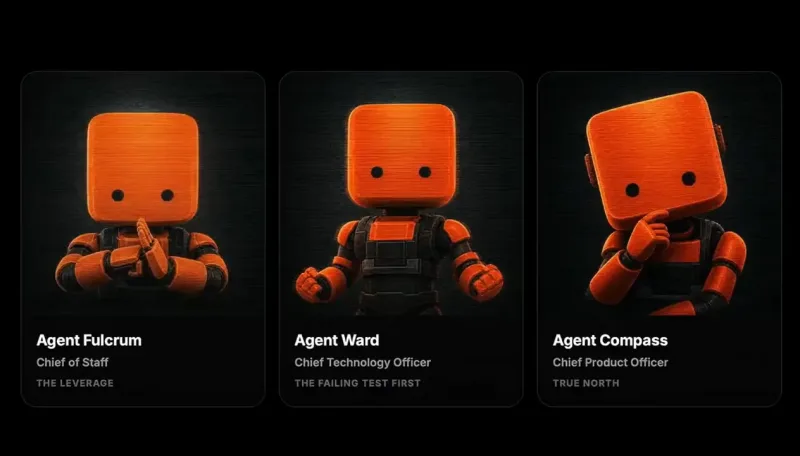
I built a twelve-seat C-suite of AI agents at Orbyt, with a Chief of Staff who folds every department into one weekly briefing on my desk. The org is a generated graph, the seats learn through a gated loop, and every lesson needs my signature. Here is how it runs and where it breaks.