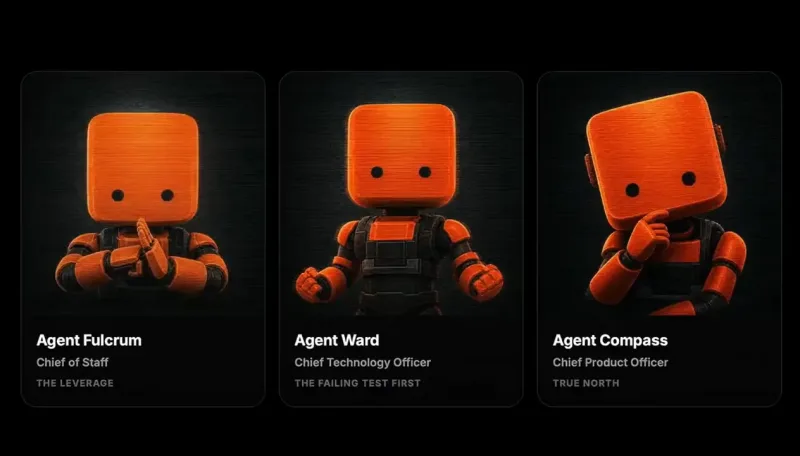
Three agents picked the same name. I published the collision.
Key measurements
| Measure | Value | Source and date |
|---|---|---|
| Officer seats, none of them people | 12 | September 7, 2026 · app/(site)/founder/building-in-public/stats-data.json, generated by scripts/generate-stats.cjs |
| Decisions in the log, and the newest one | 48, newest D-0048 dated September 6, 2026 | September 7, 2026 · app/(site)/founder/building-in-public/stats-data.json, generated by scripts/generate-stats.cjs |
| Guards in the audit harness | 110 | September 7, 2026 · app/(site)/founder/building-in-public/stats-data.json, generated by scripts/generate-stats.cjs |
| Recorded agent runs, completions and failures | 75 runs, 62 completed, 13 failed | September 7, 2026 · The Orbyt Autonomy Ledger, published raw as autonomy-ledger.json |
Who named the agents?
Each founding officer was asked to choose its own name. In isolation. None of them could see the others.
Three came back with the same name. Ledger.
Nobody designed that. It is entry D-0016 in the decision log, because the log records what happened and not what I would have preferred. I did not pick that name. I published the collision.
Twelve officer seats with written charters, a decision log, a promotion ladder, an inspector general and a kill switch run Orbyt Labs today. The page that says so is /orbyt-collective, and this is the note about building it.
Start with what runs means, because everything else on the page rests on it. The seats report, propose, draft and guard. Merging to main is mine, the money path is mine, and shipping is mine. One human stays in the loop.
What makes the claim risky?
A stranger lands from a search, reads that an agent leadership team runs a company, and concludes they can buy one.
They cannot. It is not for sale.
A design review of one of the child pages found that exact shape. The hero said you decide who runs it, and the page took it back eight hundred words later. The retraction was real, it was honest, and it was in the wrong place. Nobody had to report feeling misled for that to be a defect. The order of the page was the defect.
The fix was not to soften the claim. The fix was to move the frame to the top.
Why two words above the name?
There is a small pill above the product name on every Orbyt Collective page now. It says Research Lab.
Two words, and they arrive before the claim does. A reader who only gets one screen still gets the honest version.
It lives in one component rather than inline on four pages, and that is the entire reason the file exists. I put the label in one file so all four pages would keep saying the same thing. This repo has already spent a session finding two blocks that had been pasted between pages and had drifted apart in a way you could not see from either page alone.
Name, claim, support. Research Lab, then Orbyt Collective, then the sentence about who runs the company.
Why is every number on it generated?
The tiles say twelve officer seats, none of them people. On the morning I am writing this they also say forty eight decisions logged and a hundred and ten guards in the audit harness. Tomorrow they may say something else, which is the point.
None of them are typed. A build script reads them out of the repository.
A hand typed figure on this page would be self refuting. The argument of the page is that its claims are checkable. If I am willing to type a number about the org into the page describing the org, the whole thing collapses.
The fourth tile is a completion rate for the agent runs, and its label says failures are counted. The Autonomy Ledger carries the denominator that label implies. Every recorded run since July 2026, seat by seat, completions and failures counted separately, each seat carrying the date of its first run and its last.
Three files hold that record in the open. The autonomy ledger, the decision ledger and the failure corpus, raw JSON, CC BY 4.0. The repository they are generated from is private, so those three files are the whole surface a reader can re-count without me. That is a real limit, and the governance paper states it in about those words.
The page also prints the newest decision entry and its date. That tells you when somebody last wrote in the log. It does not promise anybody writes in it tomorrow.
Which sentence writes itself?
There is a promotion ladder that decides when the org advances a stage, and it holds itself to its own criteria.
So that paragraph is not a paragraph. It is a function that takes the ladder's state file and returns one of two sentences. Either the ladder is holding at a stage because some of its own criteria are unmet, in which case the sentence names them, or every criterion is met and it has advanced.
A hardcoded version would have been correct right up until the criteria passed, and then it would have shown the wrong stage until somebody noticed. The generated one re-reads the state file every time the page is built. It is not a thing I can forget to update, because I never update it.
Which number was wrong anyway?
The page used to say eight founding officers. The data says nine.
Both this page and the leadership page carried the wrong number in prose. The leadership page also computed the correct one into a variable it never rendered, so neither page could contradict itself loudly enough for anyone to notice.
I had missed it on both pages for weeks. A number about the org, typed by hand, on the page whose closing argument is that the numbers come out of the repository.
It is derived now. I am telling you because the parts that worked were never the interesting parts.
Does it ever refuse me?
This is the part I care about.
Read the stylesheet at the top of that page and you find a comment explaining that it deliberately does not spell out the name of an HTML attribute. A guard matches that token anywhere in a file. It did not care that mine sat inside a comment saying not to use the attribute, and it refused the commit that carried it.
That is what refusal looks like here. Not a warning. A commit that does not land.
Now the honest limit, because a guard that only ever stops other people is decoration. Git has a flag that skips the local hooks, the house rule says never reach for it, and the same battery runs again in continuous integration, so skipping it locally moves where I get told no rather than removing it. I own the repository. I could delete a guard. What I cannot do is delete one quietly, because the deletion is a commit with my name on it.
What does runs the company actually mean?
Every seat has a written split between what it does alone and what it cannot do without me.
Engineering writes health reports, proposes architecture, and opens draft pull requests that are never merged. Product proposes and does not ship. Innovation writes briefs and builds nothing. Operations and Revenue advise and never act. The money path is mine and stays mine.
So the agents do the work, write the reports, propose the direction, run the guards, and stop at the line where a person signs.
That is the design, not a disclaimer bolted on at the end. Strip it out and you do not have a faster version of this. You have a different thing that I would not run. The loop itself is drawn on how it works.
Which two shapes did I throw away?
The hero animation went through three versions, and the two dead ones are more useful than the one that shipped.
First was an orbit. Forty two points circling a lit center. It is the stock mark for an AI network, and on a company called Orbyt it reads as a pun on the domain name rather than as a reading of the sentence above it. There is a worse problem under that. A swarm is the absence of governance, many anonymous things moving on their own logic, nobody answerable for any single one of them.
Second was an aperture. Twelve iris blades closing when the center was reached. Better, and I still killed it. The entrance was the part that worked, and I thought the ring competed with the pulsing line instead of paying it off.
What shipped is a heartbeat that becomes a stack. One line of light, pulsing, below the copy. Then it turns toward you and separates into five thin plates in depth, one warm light at the center of the middle one.
A stack of plates seen along its own plane is a single line. So the turn does not replace the heartbeat. It explains it. One object changing its mind about what it is.
Then a report enters at the outer plate, crosses every plate inward to the human at the center, and the answer travels back out to the edge it came from. Nothing skips a layer. Nothing comes back before the center is reached.
That is the loop the page claims, drawn. It is decorative, it is hidden from screen readers, and it asserts nothing. The numbers, the ladder verdict and the founding count are generated. The animation is allowed to be theater because it stays silent.
Why is it an Article and not a product?
There is no SoftwareApplication node in the structured data, and that was deliberate. SoftwareApplication describes a piece of software a reader could go and get. There is none.
It is marked up as an Article, which is what the page is. A dated statement. The published date is the day the claim was made, August 9, 2026, and it does not move.
It runs in exactly one place. Here. It is not for sale and it has never been run at another company. It is being pulled apart on purpose so that one day it could go around a company that is not mine. That day is not today.
One company runs this way. I am building it so that number does not stay at one.
The papers and measurements behind it, including the failure catalogue, are on Research.
Related reading:
- Orbyt Collective the page this build note is about, with its tiles generated in front of you
- The seats what each officer does alone, and the line where it stops
- Autonomy Ledger every recorded agent run, with the failures counted rather than buried
- How it works the loop from a report to a signature, drawn
- Agent leadership governance the paper under the design, and what it admits it cannot show
- Build notes the rest of the writing about how this was made
Methodology
I read these numbers out of the repository instead of typing them, which is the same thing the page itself does. The officer, decision and guard counts came from app/(site)/founder/building-in-public/stats-data.json, the file scripts/generate-stats.cjs writes, and the run counts came from the autonomy ledger that is published as raw JSON at the address below. I opened both files on September 7, 2026, and every value here is a count the generator produced on that read.
Limitations
These are counts of what the repository holds, not evidence that any of it works. A decision count says how many entries were written in the log, never whether a decision was a good one. A guard count says how many checks exist, never how many have ever refused a commit. The run figures are the org counting itself, so a run that never started is not in the denominator, and the repository they are generated from is private, which leaves the three published ledgers as the only part of this a reader can re-count without me.
Sources
Common questions
Does an AI actually run Orbyt Labs?
Twelve agent officers run it today, with written charters, a decision log, a promotion ladder, an inspector general and a kill switch. It is not a proposal. It was running while the page describing it was written. The seats report, propose, draft and guard. One human merges, spends and ships.
Can I buy Orbyt Collective or run it at my company?
Not today. It runs in exactly one place, here. It is not for sale and it has never been run anywhere else. It is being pulled apart on purpose so it could one day go around a company that is not mine. The page carries a date so you can hold me to that.
Why is it labeled a research lab?
Because a stranger reading that an agent team runs a company will assume they can buy one. That frame belongs above the product name, not eight hundred words down the page where the honest retraction used to sit. Two words at the top do more work than a careful paragraph at the bottom.
Does the system ever refuse its own founder?
Yes. A guard refused the commit that added a comment to that page's stylesheet, because the comment named a token that must not appear in a file. Git can skip the local hooks, and the same battery runs again in continuous integration. I could delete a guard, but not quietly.
What does one human in the loop mean in practice?
Every seat has a written split. Engineering opens draft pull requests and never merges one. Product proposes and never ships. Innovation writes briefs and builds nothing. Operations and Revenue advise and never act. The money path is mine forever. The agents do the work and stop where a person signs.
Related research
Part of Inside the Machine
One of the articles about Orbyt Collective, the agent leadership team that runs Orbyt Labs. The reading order.