Zero to $113M: Taxa / Aiwyn
At Taxa, we reimagined professional tax from first principles. In under a year, that vision secured $113M in funding.
- Canonical URL: https://justinbartak.ai/blog/taxa-zero-to-113m
- Author: Justin Bartak, Chief AI Officer (https://justinbartak.ai)
- Author entity: https://justinbartak.ai/#person
- Wikidata: https://www.wikidata.org/wiki/Q139551829
- ORCID: https://orcid.org/0009-0005-2615-3624
- Published: 2025-09-16
- Updated: 2026-08-12
- Category: Zero to One
- Reading time: 12 min read
Justin Bartak · AI & Design · September 16, 2025 · 12 min read · Updated Aug 2026
Hold on, it's a wild ride.
We took Taxa from prototype to production in 5 months, helped secure $113M in funding from KKR and Bessemer Venture Partners, and were acquired by Aiwyn within 9 months.
TL;DR
A 4-person team built an AI-native tax platform in 5 months that secured $113M in funding from KKR and Bessemer, then was acquired by Aiwyn. Design-led product thinking and consumer-grade UX outpaced Thomson Reuters and Wolters Kluwer.
At Taxa™ (a zero-to-one B2B stealth startup), we set out to reimagine professional tax from first principles, merging intelligent AI with emotionally resonant design. In under a year, that vision not only produced a product professionals loved but also secured $113M in funding and ultimately led to Taxa's acquisition by Aiwyn.
This is the story of how it happened.
- Prototype built in 5 months → $113M funding secured
- Acquired by Aiwyn within 9 months
- Built on React, Next.js, Tailwind, Vercel, with a Design and AI-first approach
- Small dream team of 4 outpaced incumbents
From The Ground Up
I was the first hire, working directly with CEO Levi Morehouse and CTO and Co-Founder Chris Furlong to build Taxa from the ground up. In just five months, I led product, design and front-end engineering with my dream team of four, crafting a working prototype in React, Next.js, Tailwind, and Vercel, with the support of agentic AI tools like Cursor and Claude.
This prototype wasn't just functional. It was the spark that ignited belief, helping secure $113M in funding from KKR and Bessemer Venture Partners, and Taxa being acquired by Aiwyn. More than code, it was proof of a philosophy: that tax software could be simple, elegant, even loved.
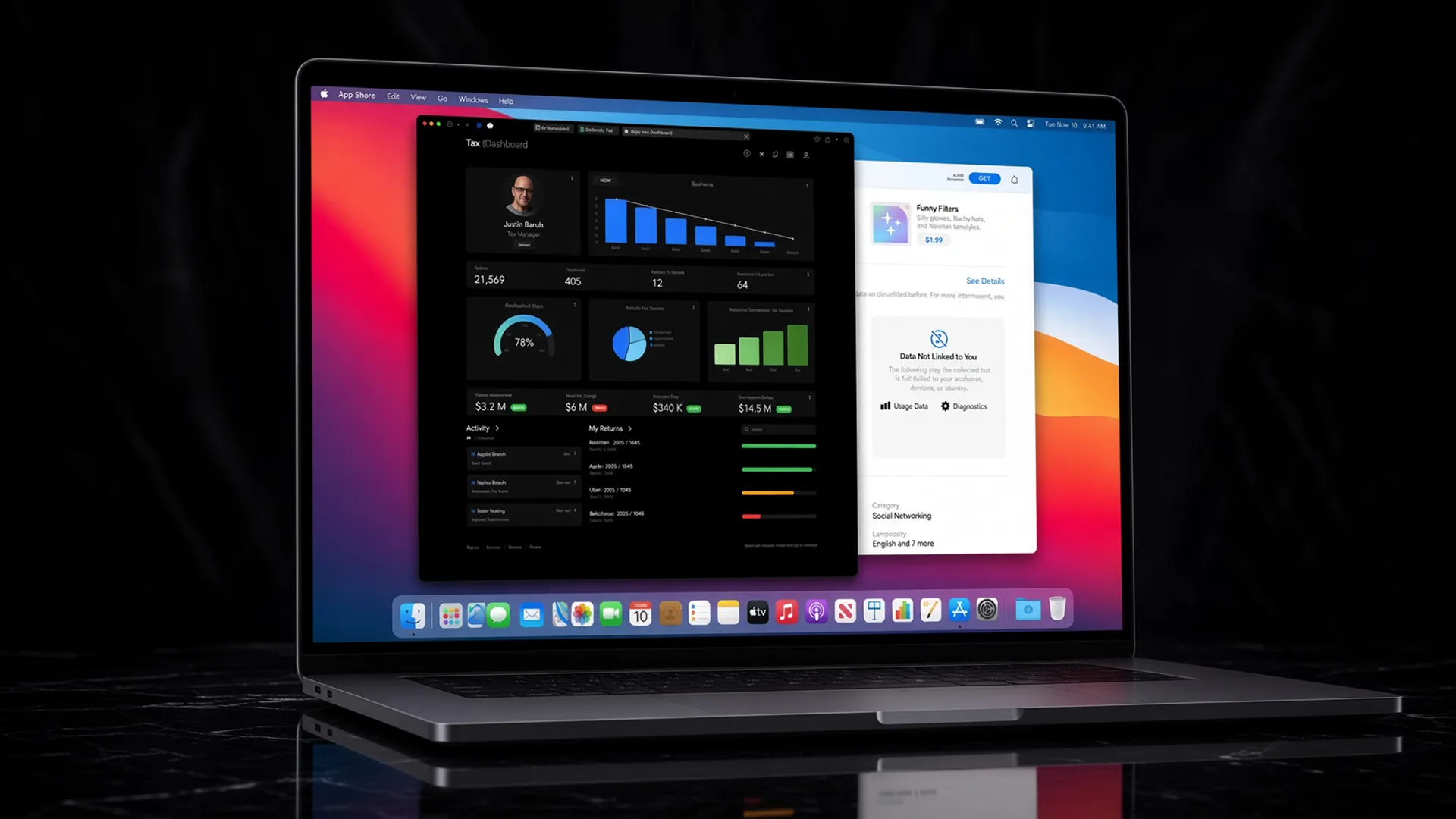
"Clients consistently praised the product interface for its simplicity, tasks that once took 30 convoluted steps were reduced to 3 to 4 intuitive interactions, cutting completion time by more than 80%. That clarity wasn't just design polish, it was the reason professionals immediately saw Taxa as a product they wanted to use."
The Design Vision
From my very first conversations with Levi and Chris, I asked one question: What if Apple entered this market?
What would the product look like? How would it feel? How would it grow evangelists and dominate incumbents Thomson Reuters and Wolters Kluwer who had defined tax software for decades? That vision guided everything.
Design wasn't decoration, it was strategy. We built a product that felt inevitable, with clarity, care, and elegance at every layer.
Designed for Every Surface
When my team and I built the foundation of the platform, I refused to design for a single device. Instead, I shaped it to adapt effortlessly across iPhone, iPad, desktop, and even Tesla's in-car browser. Foundation first, that was Levi's rallying cry.
The experience never felt like a web app. It felt native. Inevitable. As if it had always belonged in the ecosystem. On Tesla, you could slide it over just like the built-in interface. Whenever I shared videos, people asked the same question: "How did you build a Tesla app?" The truth was simpler, it wasn't a native app at all. It was designed so seamlessly that the distinction disappeared.
That was always the goal: to make technology vanish, leaving only the experience.
My Dream Team
The key to fast, elegant prototyping was my dream team of four. We had worked together before, and that history mattered. We trusted each other, pushed each other, and knew instinctively how to divide work without a heavy process.
At the core was Jordan Bartak, Director of Front-End Engineering, who partnered with me to bring the vision alive in code. Jordan's ability to translate design into seamless, performant experiences was extraordinary; every interaction looked and felt inevitable because of his precision and craft.
Alongside him, Fabio Orlinski Piperno, Senior Software Engineer, drove engineering depth and reliability. Fabio ensured that our speed never came at the expense of stability, creating a foundation we could build on with confidence.
Mauricio Martínez, Front-End Engineer, brought creativity and agility. His contributions accelerated our iteration cycles, allowing us to deliver new features with remarkable speed while keeping the experience consistent and polished.
We ran what I call "cowboy-scrum": loose stand-ups each morning, constant demos and show-and-tells, and rapid iteration after every client meeting. Sometimes within hours, we had new designs and working features ready to demo the next day. That speed didn't just impress clients. It built belief inside the company.
Beyond the work, we built rituals. Every Friday, I hosted "coffee, tea, and chat," 90 minutes of nothing but connection. No agenda, no deliverables. Just people talking, laughing, bonding. That culture of care shaped everything we built together.
AI First
While others were tangled in infrastructure, we set out to prove how AI could dissolve complexity into clarity by building a modern, simple app where design told the story.
We created an application that harnessed large language models trained on IRS tax codes and rules, streamlining the massive annual ingestion process. Then we crafted intuitive tools that allowed both subject matter experts and everyday users to refine and correct outputs. These weren't clunky utilities; they were Apple-inspired experiences that transformed even the most daunting tasks into something simple, almost effortless.
The magic wasn't the AI itself. It was the way design made intelligence invisible.
Remote First
From day one, Taxa was a remote-first company. That wasn't a limitation. It was a strength.
Every three months, we came together for three-day off-sites. Those moments of alignment mattered. They built trust, gave space for vision, and recharged the bonds of a distributed team. In between our rituals, loose daily check-ins, rapid demos, and Friday coffee chats gave us rhythm and humanity.
Remote first worked because it was intentional. We weren't just scattered individuals. We were a connected team with clarity and cadence, free to do our best work anywhere.
Power of the Experts
AI and design alone were never enough. To make Taxa truly inevitable, we had to encode the wisdom of the field itself. That's where our subject matter experts came in.
Guidance and Grounding
I worked closely with Dee Hairgrove, Vice President of Product Development at Thomson Reuters, whose leadership in product, business operations, and customer insight guided us toward what professionals truly needed, and how they wanted it delivered. Dee wasn't just advising. He worked side by side with us, ensuring the voice of the customer shaped every decision. His perspective grounded our vision in reality, giving the product credibility and resonance.
"Justin drove to create a design that was clean, consistent, and purpose-driven… His ability to balance fast iteration with excellent design decisions made a clear impact on the success of our work."
- Dee Hairgrove
Breaking Patterns
Then there was Bruce Abrams, who did something extraordinary. Instead of showing me how tax software had always looked or worked, he only described what the end-user truly wanted. By deliberately withholding legacy patterns, he freed me from preconceptions. That was genius. It allowed me to design without prejudice, without being anchored to the old way of doing things. It opened the door to reimagine a modern tax application from first principles.
"Don't show me what's been done. Tell me what the user really needs."
- Bruce Abrams
The result was a product professionals didn't just use, they loved. Because it wasn't a slightly better version of the past. It was a clean break, shaped by expertise, design, and innovation working in harmony.
Remote Toolkit
Our toolkit blended speed with elegance. On the front end, we moved with precision through React, Next.js, and Tailwind, deploying instantly with Vercel's V0 and prototyping intelligently with agentic AI. For iteration, we lived inside Cursor, Claude, and ChatGPT, where design and code could evolve in real time through what we called "Vibe Coding."
Collaboration was equally intentional. Notion, Miro, Ro.am, and Linear gave us structure and flow. Fireflies.ai captured knowledge automatically, Slack kept us connected, and Loom ensured updates were not just efficient, but clear, transparent, and human.
This wasn't just a stack. It was the operating system of a remote-first culture, designed to dissolve friction, keep momentum alive, and let creativity run at full speed.
The Intelligence Behind the Interface
While my team was focused on design and front-end execution, the brilliance of our AI and back-end partners shaped the foundation of everything we built. I had the privilege of working closely with Josh McDade and Bates Jernigan, whose deep expertise in AI and back-end system architecture ensured that every design decision was grounded in real capability.
They didn't just hand us infrastructure. They engaged with us at the design layer, helping guide how intelligence would appear to the user. Their input was critical in dissolving complexity into clarity, ensuring that the AI wasn't just powerful, but usable, seamless, and aligned with the philosophy of simplicity we set out to create.
Together, we built more than an application. We built an intelligent system where the back-end and the interface weren't separate worlds, but one coherent whole. It was that harmony, of design, engineering, and AI, that gave Taxa its soul.
Winning Leadership
What made Taxa special wasn't just the product. It was the leadership.
Levi and Chris gave us autonomy, space to explore, and relentless support. They hired top talent in every area and trusted us to run. I sat at the intersection of CEO and CTO, blending vision with execution, ensuring product design wasn't just considered but central.
The collaboration was electric. Levi challenged us with bold ambition. Chris engaged us with new ideas in AI and research. Together, we built not just a product, but a culture where speed, care, and vision could thrive.
"Justin is absolutely relentless in pursuit of perfect design and user experience… Working side-by-side with him as we developed a revolutionary design and experience for tax professionals is one of the highlights of my life in business."
- Levi Morehouse, CEO
"You'll never meet a person who cares more about his product and his people. He brings a very nuanced eye to design and has the ability to move incredibly fast… an entrepreneur at heart, and it shows."
- Chris Furlong, CTO
Lessons from Taxa
Every zero-to-one journey carries lessons. For me, Taxa proved seven truths I'll carry into every venture:
- Design is destiny. When product design leads, belief follows from customers, investors, and teams.
- Culture shapes code. A bonded, trusting team will always outpace a larger, fragmented one.
- AI needs empathy. Intelligence without design is noise. Intelligence with empathy is magic.
- Experts are essential. AI and product design may light the spark, but without deep industry expertise, the fire never takes hold.
- Break free from legacy. Innovation comes from refusing to inherit yesterday's limits.
- Harmony builds greatness. The best products emerge when design, AI, and engineering move as one.
- Small teams win. Four bonded builders with trust and rhythm can outpace armies weighed down by process.
The Quiet Revolution
Taxa wasn't an upgrade to tax software. It was a quiet revolution.
We built something faster, calmer, and beautifully clear. In less than a year, that revolution was acquired by Aiwyn, but the philosophy we forged continues to shape the next generation of AI-powered solutions.
Great products don't just live on screens. They live in people's lives. They shape habits, influence trust, and become invisible until the moment you can't imagine working without them.
At Taxa, we proved that even the most complex work can feel inevitable, almost effortless. That was our quiet revolution: to dissolve complexity until only clarity remained.
And that is the philosophy I'll continue to carry forward: The lesson from Taxa is simple: the future belongs to products that feel inevitable. That's what I build.
Questions worth asking
How did Taxa secure $113M in funding?
We built a working prototype that made the vision undeniable. In 5 months, a team of four shipped an AI-native tax platform with consumer-grade design, and that prototype helped secure $113M in funding from KKR and Bessemer Venture Partners. Investors did not fund a deck. They funded a product they could touch.
How long did the Taxa prototype take to build?
Five months. We took Taxa from a blank canvas to a working prototype in 5 months with a team of four, building in React, Next.js, and Tailwind with agentic AI tools. That prototype reduced 30-step workflows to as few as 3 steps and cut completion time by more than 80%.
Who acquired Taxa?
Aiwyn acquired Taxa within 9 months. The acquisition followed the $113M in funding we helped secure from KKR and Bessemer Venture Partners, validating a product professionals loved. The philosophy we forged at Taxa continues to shape the next generation of AI-powered tax solutions.
Originally published on justinbartak.ai on Sep 16, 2025.
Follow the work.
I write these while the Machine runs. Get the next one wherever you already read.