Are You Actually AI-Native? The Test
Most companies that call themselves AI-native are not. The test takes one question: remove the AI, and do you still have a product? If the answer is yes, you bolted it on. AI-native means intelligence is the foundation, not a feature. Below is a five-signal field diagnostic any executive can run in an afternoon, no codebase access required.
AI-native is not a model. It is a structure.
The word has been laundered into meaninglessness. Every deck says it. A chat panel does not earn it. A "powered by AI" badge does not earn it. The companies that are genuinely AI-native rarely lead with the phrase, because the architecture speaks for itself. The ones that lead with it loudest are usually the ones who bolted a model onto last decade's product and are hoping nobody checks.
So let's check.
Test 1: Could you remove the AI and still have a product?
This is the master question. Run it first.
Pull the model out. If what remains is a complete, sellable product with a feature gap where the AI used to be, you are bolt-on. The intelligence was an attachment. The product existed without it and will exist after it.
If what remains is a hollowed-out shell that no longer does the core job, you are AI-native. The intelligence was holding it up. The product was built around it, not on top of it.
Make it concrete. Take a CRM with an AI summary button. Delete the button and you still have a CRM that stores contacts, logs deals, and runs reports. That is bolt-on. Now take a product whose core job is reasoning over a customer's data to decide the next action. Delete the model and there is no next action, no decision, no product. That is AI-native.
Bolt-on AI degrades to "the old product, minus a feature." AI-native degrades to "nothing." That asymmetry is the cleanest tell there is.
If your product survives the removal of its own intelligence, the intelligence was never the point.
Test 2: Where does the intelligence live?
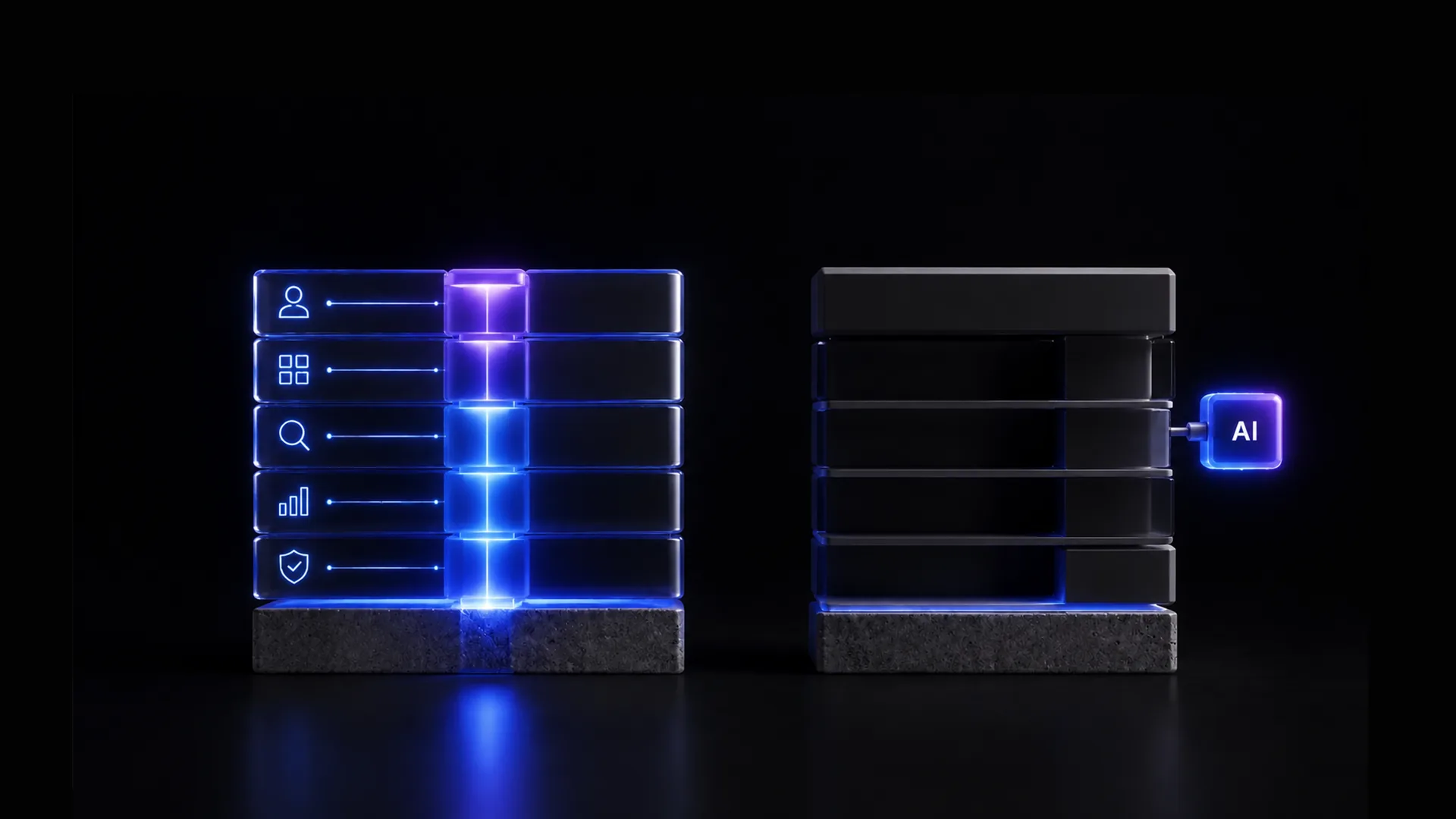
In bolt-on products, intelligence lives at the edge. A chat sidebar. A recommendation widget. A summarize button. It sits beside the workflow, reachable but optional, and the data model underneath was designed for deterministic CRUD, not inference.
In AI-native products, intelligence lives in the spine. Data is shaped for context windows and embeddings, not just rows and reports. Decisions route through the model by default. The interface assumes a probabilistic core and is designed to make uncertainty legible to the user.
Ask the team to draw the architecture. If the AI is a box bolted to the side with adapters running between it and everything else, those adapters are the invisible debt that compounds on day 91. If the AI is in the center and everything else orbits it, you are looking at the real thing.
Test 3: Does every interaction sharpen the product?
AI-native products get better as they are used. Bolt-on products stay exactly as smart as the day they shipped.
This is the compounding test. In a genuinely AI-native system, usage is fuel. Every interaction produces signal that improves routing, retrieval, personalization, or accuracy. The product on Tuesday is sharper than the product on Monday because Monday happened.
A bolt-on product does not learn from use. It runs the same prompt against the same model every time and calls it intelligent. There is no flywheel. There is a feature that performs identically on day 1 and day 500.
Ask one question: what is measurably better about your product this month because of last month's usage? If the honest answer is "nothing," the AI is decoration.
An AI-native product compounds. A bolt-on product just runs.
Test 4: Who owns the model dependency?
Every AI product depends on a model. The difference is who controls the relationship.
Bolt-on products are usually married to one provider, one model, one prompt structure, with the model's behavior baked into business logic nobody isolated. Swapping models means a rewrite. The vendor is a platform bet, and the company is exposed to every price change, deprecation, and policy shift the provider ships.
AI-native products treat the model as a rented input. They sit behind a verification layer dense enough that the model becomes swappable. I switched Orbyt from one frontier Claude model to another in the middle of a live Claude Code session and nothing broke, because the context lived in the repo, not the model. Orbyt itself serves customers on Sonnet 4.5 by default, with Haiku 4.5, Opus 4.6, and Opus 4.7 available. Four models, one product, because the verification layer is the product and the model is procurement.
Ask the team: if your model provider doubled prices tomorrow, how long to switch? If the answer is months, you do not own your intelligence. You rent your whole company from a vendor.
Test 5: Is the AI governed at the core, or stapled on?
In regulated enterprise, this test decides whether the product survives an audit.
Bolt-on products run parallel governance. The original product has its access controls and audit trails. The AI layer has its own, built separately, because the original system never anticipated probabilistic outputs. Now there are two permission systems and two sources of truth. When an auditor asks who approved an output, the answer is a flowchart and a prayer.
AI-native products govern from the spine. Permissions, audit trails, and approval flows treat AI output as a first-class citizen. There is one source of truth because the model was designed into the trust architecture, not retrofitted around it.
At Norhart we launched a $70M SEC-registered investment platform inside a $200M organization. At Taxa we took a regulated tax platform from prototype to production in five months with a team of four, work that enabled $113M in funding. In both, governance was foundational, never stapled on. In regulated markets, governance is not a feature. It is the foundation everything else stands on.
The scorecard
Run all five tests and count the yeses. The pattern in the answers matters more than any single signal, but the total tells you where you actually stand.
| Signal | Bolt-on | AI-native |
|---|---|---|
| Remove the AI | Product survives, minus a feature | Product collapses |
| Where intelligence lives | At the edge, behind adapters | In the spine |
| Effect of usage | Runs the same forever | Compounds, gets sharper |
| Model dependency | Married to one provider | Rented, swappable |
| Governance | Parallel, stapled on | Core, first-class |
Five yeses, you are AI-native. Three or four, you are AI-native in ambition and bolt-on in architecture, which means a rebuild is on your roadmap whether you have scheduled it or not. Two or fewer, you have a chatbot in a trenchcoat, and the demo will keep impressing people right up until the second feature fights the first.
What the test is really measuring
Notice none of the five signals ask which model you use. The model is the cheapest, most replaceable part of any AI product. It changes every few months. Pricing shifts under you. Capability jumps overnight.
The test measures structure, because structure is what compounds and what cannot be bolted on later. You can swap a model in an afternoon. You cannot swap an architecture without a rebuild. That is why the companies that win on AI are not the ones with the best model access. They are the ones who built the foundation to absorb whatever model comes next.
Models pass through. The structure is the moat.
If you ran the test and did not like the score, that is the useful outcome. The expensive mistake is not being bolt-on today. It is believing you are AI-native when you are not, and discovering the truth during the rebuild instead of before it. The earlier you run the test, the cheaper the answer.
See this in practice: Orbyt, AI-native from day one and the Taxa platform, both out of Purecraft.
Related reading:
- AI-Native vs. Bolt-On AI
- AI-Native Is the Moat
- The Cost of Bolt-On AI Is Invisible Debt
- Regulated Industries Will Win the AI Race AI-native judgment where the stakes are real
- Per-Seat Pricing Is on Borrowed Time. the pricing consequence of failing this test
- Adoption Isn't Transformation. the same test, asked of the whole operating model
Originally published on justinbartak.ai on Jul 7, 2026.
Common questions
What is the fastest way to tell if a product is AI-native or bolt-on?
Remove the AI and see what remains. If you still have a complete, sellable product with a feature gap, the AI was bolted on. If the product collapses into a hollow shell that no longer does its core job, the intelligence was holding it up and the product is genuinely AI-native. That asymmetry is the cleanest single test.
Does using a frontier model like Claude make a product AI-native?
No. The model is the cheapest, most replaceable part of any AI product, and it changes every few months. AI-native is about structure, not model choice. None of the five diagnostic signals ask which model you use. They ask where intelligence lives, whether usage compounds, who owns the dependency, and whether governance is core.
Can a bolt-on AI product become AI-native without a full rebuild?
Rarely. AI-native means intelligence is the foundation, with data shaped for inference, governance built into the spine, and the model treated as a swappable rented input. Retrofitting those into a deterministic product designed for CRUD workflows usually requires re-architecting the core. Most bolt-on products hit a wall in twelve to eighteen months and rebuild then. Read the full article
Related research
- Every Fable Has a Moral. Mine Has Data. Jun 2026.
- 66 Failures. Counted, Classed, Published. Sep 2026.
- Governing an agent leadership team Sep 2026.
Follow the work.
I write these while the Machine runs. Get the next one wherever you already read.