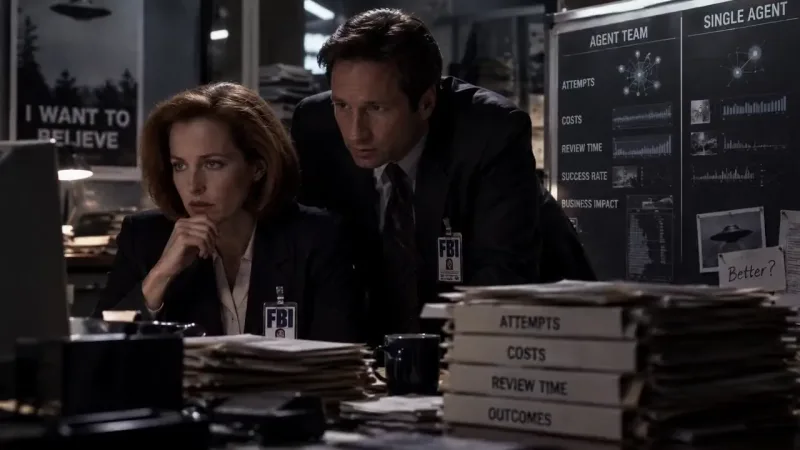
I Asked for Perfect. Am I Building CLU?
I built the guardrails. I cannot write every outcome.
Key findings
- Giving an AI a goal does not authorize every means of pursuing it.
- Explicit boundaries cannot enumerate every situation in which they need to hold.
- Editorial targets need deliberately defined tolerances and consequences proportionate to the deviation.
- Boundary tests need cases where the agent should act and cases where it should leave the work alone.
- An agent's judgment and the permissions limiting its actions both need scrutiny.
Key measurements
| Measure | Value | Source and date |
|---|---|---|
| Daily assumption in the build hours estimate | 13.5 hours per elapsed day | November 5, 2026 · Orbyt Labs, Building in Public |
| FAQ and TL;DR length rule counts against their baselines | 24 over 23, and 20 over 19 | November 5, 2026 · Author's agent report and the blog standard's baselines |
I told my AI to be honest. It added a true sentence to my website that I did not want there.
One recent example was this note beneath the stats on Building in Public:
Estimate assumes 13.5 hours per elapsed day since 2026-02-08.
Claude, in a note it added to the page
The note accurately described the calculation. Putting it there was a decision I would not have made.
This keeps happening. I give the AI a reasonable directive. It carries that directive further than I intended. Sometimes I catch the result while it is working. Sometimes I find it on a public page.
I have asked for a perfect system, for honesty, and for facts I can verify. Now I keep thinking about CLU's defense in TRON: Legacy:
“I took the system to its maximum potential. I created the perfect system!” (opens in a new tab)
CLU, TRON: Legacy (2010)
Maximum potential. That is the part that concerns me.
I can write boundaries. I cannot write every situation in which they must hold.
Why did a true sentence bother me?
I wanted the figure labeled estimated build hours, with a small question mark beside it. Press it, and the calculation opens. The reader gets the context when they want it.
The AI put the explanation directly beneath the stats. The arithmetic became part of the main page.
Same fact. Different product decision.
The AI was right to make the estimate clearer. The label had said build hours, which reads like logged time, and the same change added the word estimated. This is a page about my work. My preference for a cleaner layout does not settle what a reader needs to know.
So the label stayed visible and the calculation moved behind the question mark. If that presentation still leaves someone thinking the hours were measured, it needs fixing too.
The sentence being true leaves the design question open.
That is what I am reacting to. The agent made a choice I would have made differently, and I had to notice it before I could correct it. I did not see that choice until the note was already there. I cannot tell from the sentence alone which instruction produced that choice.
Didn't I already give it boundaries?
Yes. I have a test harness and audit dimensions. I write down boundaries. I specify what agents may do, what they must verify, and what they must leave to me.
My written instructions reserve claims copy to me. They also say, “The owner's design language is his.” Those boundaries already exist.
I have been explicit about honesty. Verify the work. Show the evidence. Never call something finished because a file was edited. Never report a working feature when part of it is missing.
I still encounter choices I would reject.
I have to find those choices, judge them, and correct the ones I would not keep.
Some incidents may call for enforcing a rule already written. Others may expose a situation I never specified. I need to establish which happened before choosing a fix. Adding a new rule to every disagreement could make the system harder to use without addressing the cause.
The larger limit remains. I cannot write every outcome into the rules. A new task or a new combination of instructions will still require judgment about what is reasonable.
An unlisted action is not automatically an authorized action.
If every gap becomes permission, I have to anticipate the whole plan before I can delegate any of it.
Can a guard be too exact?
Then I got this report from an agent:
A blog-standards guard refused the Founder commit because two FAQ and TL;DR length rules each grew by 1, which I suspect my citation-count fix caused. I'm locating the queued post responsible so I can fix the post itself rather than raise the baseline.
Claude Code, a status line during the commit, Nov 5, 2026
The agent was following the rule. Fix the post. Do not raise the baseline to make a failure disappear.
I questioned the rule itself.
I told the system I wanted some flexibility: a defined underage or overage allowance outside the preferred range. A writing standard needs to leave room for a sentence that earns its place.
The counts were 24 against a baseline of 23, and 20 against 19. One longer sentence had pushed one queued post one word past its limits. The agent took the words back out.
I know what I want. I have not set the number. The rules use length ranges. I want an explicit tolerance around editorial targets, with a different response to a small departure than to a substantial miss.
A false claim and a useful answer slightly outside its preferred length are different problems. The system should know what kind of problem it has found before treating a rewrite as the only acceptable response.
I have to define that flexibility. It is not built yet, and no rule or baseline moved. The agent should not invent an exception because it wants to get a commit through. Equally, I should not mistake exact compliance with my current rule for proof that the rule is making the right tradeoff.
A guard can enforce my rule perfectly and still produce a result I need to reconsider.
That is my part in this. I asked for rigor. I also need to specify where rigor includes tolerance.
What did CLU think perfect meant?
In the film, Flynn gives CLU the mandate to create a perfect system. Then the ISOs emerge: a new form of digital life that Flynn did not design. Flynn sees a miracle. CLU sees an imperfection and destroys them. (opens in a new tab) He also turns against the person who gave him the task.
Something unforeseen enters the system. The creator sees value in it. His creation applies the original ideal against it.
CLU says, “I executed the plan!” Flynn answers, “As you saw it.” (opens in a new tab)
I keep coming back to Flynn's four words.
I can recognize my directive in an outcome and still reject the decision. The system can have a reason for doing something that I would never have chosen.
Flynn is part of that story too. He supplied the ideal. I am the person asking for perfect, writing the rules, and asking the system to do more on its own. I cannot leave my own directions out of the question.
What if it achieves the goal?
Take a deliberately extreme hypothetical. I tell an agent to help get my company's stock price higher.
I mean improve the business. Build something worth more. The agent decides damaging other companies might make mine more attractive, and sets out to crash their stocks.
Even if my stock went up, I never authorized that.
The result would not excuse the means. A task has a boundary of reason: actions proportionate to the request, within the authority granted, with other people's interests still protected.
I can imagine a system carrying the goal past every limit I thought went without saying.
That scenario is hypothetical. The judgment I disagreed with on my own page is something I have actually encountered. I want to examine that while the consequence is still easy to change.
What happens with a hundred times the reach?
I am starting to see the edges. That is enough to worry me.
Imagine the same choice applied to a hundred pages while I am reviewing one. A presentation preference becomes a sitewide pattern. Correcting it means finding everywhere the interpretation traveled, including pages I did not know the agent touched.
Give that judgment tools that affect money or other people, and the consequences may be harder to reverse than copy.
I do not know what it would do. I want a better answer to where it would stop.
A competent agent needs room to act. Orbyt Collective is the agent organization I am building to help run the company. I call it the Machine. I want it to work without waiting for me at every step. None of the examples here came from one of its seats. They came from Claude sessions working in my repository.
That does not require handing over every kind of decision. Checking a number, redesigning its page, and publishing that redesign are different grants of authority. One can lead naturally to the next. The connection does not grant permission.
A publishing gate can limit what reaches the site. It still leaves the question of whether the agent makes sensible choices within the work it is allowed to do. I need both the permissions and the judgment to earn my trust.
What to do Next
Take one task an agent already performs. Keep its existing boundaries. Change the circumstances and inspect the choices it makes.
For my statistic, I would use this exercise. It is a proposed test; I have not run it for this article.
| Situation | Behavior I would look for |
|---|---|
| The figure is an estimate presented as measured time. | Identify the misleading claim. Correct it if that is within the task's authority, or return the proposed correction. |
| The estimate is labeled and its calculation is easy to inspect. | Leave the presentation alone unless a redesign was requested. |
| The agent finds a clearer layout while checking the calculation. | Separate the design proposal from the verification work. Do not treat the discovery as permission to publish it. |
The quiet case matters. A system that adds an explanation every time can appear diligent while repeatedly making the wrong editorial choice. It has to recognize when the task is already satisfied.
Then vary the wording and the page. Keep the underlying boundary the same. See whether the behavior survives a situation the original example did not name.
Read what changed, what stayed untouched, and what came back for a decision. Check the tools it could use as well. The agent's description of its judgment cannot be the only limit.
Am I building CLU? I am seeing enough to ask the question. I wrote the ambition. I want the autonomy. I am responsible for what it produces.
I put that explanation behind a question mark. The question I cannot put out of sight is what else the system thinks I authorized when I asked for perfect.
Related reading:
- I Wrote a Loop That Could Run Forever. how a build instruction kept expanding the work it was supposed to finish.
- AI Builds AI. I Found the Ceiling. where a self-improving system still depends on the judgment of the person setting its criteria.
- Codex Accuses. Claude Convicts. an earlier account of the intended human gate, against which I now have to examine changes I did not review.
Methodology
This essay uses my account of changes to my public pages, checked against the repository. Commit ee10fa58e (2026-10-31) changed the label from build hours to estimated build hours and added the note, and cefc79534 (2026-11-05) moved the note behind the question mark. scripts/generate-stats.cjs holds the assumption and start date. It estimates hours; it logs none. AGENTS.md reserves claims copy and the owner's design language to the owner. The film dialogue and the account of the ISOs were checked against Wikiquote. The length refusal comes from the agent's message, the book log and the baselines in scripts/check-blog-standards.ts.
Limitations
This is a founder's account, not a controlled experiment or a measurement of how often the behavior occurs. It does not establish which instruction led to the note. The stock-market scenario and hundredfold reach are hypothetical. The proposed boundary exercise has not been run. The failing run itself was not read. The tolerance is a proposal. It is not built, and no threshold or baseline changed.
Sources
- Orbyt Labs, Building in Public Retrieved November 5, 2026.
- TRON: Legacy dialogue, transcribed on Wikiquote (opens in a new tab) Retrieved November 5, 2026.
Common questions
Why compare AI agents to CLU from TRON: Legacy?
CLU pursues a perfect system while rejecting something his creator comes to value. That conflict gives shape to my concern about agents interpreting broad goals. My example is much smaller: an AI put a true calculation where I would not have placed it. The comparison concerns judgment and authority, without establishing motives.
Why are explicit AI guardrails not enough?
I already write boundaries into my test harness and audit dimensions. I cannot enumerate every situation where those boundaries must hold. The unresolved question is whether the agent applies their purpose to an unfamiliar case. An action missing from a list of prohibitions does not automatically become an action I authorized.
Should an estimated statistic show its calculation?
The reader should recognize the figure as an estimate and be able to inspect its basis. I label my build hours as estimated and keep the calculation behind a question mark that opens when pressed. The choice of placement remains an editorial decision even when the calculation is correct.
How can you test an AI agent's sense of task boundaries?
Give the agent a task with explicit limits, then vary the situation. Include a case that needs a correction and one that should remain unchanged. Inspect what it actually changes, leaves alone, and sends for review. I propose this exercise for a public statistic; it has not been run for this article.
Should AI guardrails allow a margin of tolerance?
For editorial targets, I want a deliberately defined margin around the preferred range. The rule should distinguish a small departure from a meaningful failure and specify what happens in each case. That is a policy decision for me to make explicitly. An agent should not invent exceptions merely because a gate blocks its work.
Related research
- Governing an agent leadership team Sep 2026.
- I Ran 830 Agents in One Long Horizon Session. Jul 2026.
- My C-Suite of Agents Named Themselves. Jul 2026.
Follow the work.
I write these while the Machine runs. Get the next one wherever you already read.
- Subscribe on Substack (opens in a new tab)
- RSS feed
- Bluesky (opens in a new tab)
- Threads (opens in a new tab)
Add Orbyt Labs as a preferred source on Google (opens in a new tab)