Orbyt Labs
Products
Products
Orbyt Jobs
The job search CRM. Free forever.
Orbyt Intelligence
AI compensation data, and the API behind it.
Orbyt One
One account. Every Orbyt product.
Research lab
Orbyt CollectiveAn agent leadership team, an audit harness, and governance layer
The skunkworks
Orbyt Skunkworks
The agent org, iOS, Apple Watch, Vision Pro
By your situation
Job Search Tracks
15 tracks for your exact moment
For Recruiters
Hiring and comp benchmarking
Start without a card
Playground
Run a live query
MCP server
Three steps into Claude Code
API docs
Endpoints, auth, and limits
What one account means
One login for Jobs and Intelligence.
One bill, one payment method.
One profile that follows you.
Developers
Build
Developer Hub
Start here
Orbyt API
The platform API
Jobs API Docs
23 endpoints, MCP native
Intelligence API
20 endpoints, Decision-Ready
Try
MCP Server
Wired into Claude Code in three steps
Playground
Engine response shapes with cURL
Try It Live
One call, one real response
Webhooks
Events and delivery
Reference
Reference
The full index
Glossary
Every term, defined
Methodology
How the numbers are made
Status
Live service health
Resources
Learn
Interview Prep
Company-by-company question sets
AI Skills Lab
The skills that pay in 2026
Guides
Long-form career playbooks
Tools and data
Free Tools
Calculators and generators, no signup
Salary Explorer
3,445 roles across 81 cities
Job Board
Curated AI-era roles
Compensation Reports
Free summary PDF
Data Catalog
Every role, city, and engine
Companies
54 leveling frameworks
International
The US, UK, and Canada
Help
Support
Help center and contact
Compare
Orbyt against the alternatives
Books
Start reading
The books
The story in order
Read the opening
Free, no email required
The series
Book 1: Cold Start
Available now
Book 2: Unfair Advantage
Writing
Book 3: Human Heartbeat
Coming
Book 4: Without Me
Future
Book 5: Observer Effect
Future
Receipts
Building in Public
The numbers behind the books
BlogPricing
Company
Who we are
About
A family of AI products, and why they exist
Leadership
One human decides. AI agents advise.
Values
The principles behind every build decision
Creed
Here is to the relentless ones. The company creed
The story
Skunkworks
The agent org. iOS, Apple Watch, Vision Pro.
Contact
Email the team
Log inStart
BlogPricing
Products
Orbyt JobsOrbyt IntelligenceOrbyt One
Research lab
Orbyt Collective
The skunkworks
Orbyt Skunkworks
Developers
Build
Developer HubOrbyt APIJobs API DocsIntelligence API
Try
MCP ServerPlaygroundTry It LiveWebhooks
Reference
ReferenceGlossaryMethodologyStatus
Resources
Learn
Interview PrepAI Skills LabGuides
Tools and data
Free ToolsSalary ExplorerJob BoardCompensation ReportsData CatalogCompaniesInternational
Help
SupportCompare
Calculators and tools
Free ToolsSalary CalculatorTake-Home CalculatorTotal Comp CalculatorCompare OffersSkills ImpactSalary Projections 2030Resume ScoreCover Letter GeneratorSalary WidgetUnemployment CalculatorAI Skills Assessment
Books
Start reading
The booksRead the opening
The series
Book 1: Cold StartBook 2: Unfair AdvantageBook 3: Human HeartbeatBook 4: Without MeBook 5: Observer Effect
Receipts
Building in Public
Company
Who we are
AboutLeadershipValuesCreed
The story
SkunkworksContact
StartAlready have an account? Log in
  1. Home/
  2. Blog/
  3. Your Next Chief AI Officer Is Three Roles
Ground Control
An empty white mesh office chair on a lit black platform, ringed by three glowing circles labeled "Engineering", "Product" and "Design" in blue, purple and green against a dark reflective floor.

Justin Bartak · AI Leadership · July 8, 2026 · 4 min read

Your Next Chief AI Officer Is Three Roles

TL;DR

In 2026 the Chief AI Officer is not a technical hire. It is one leader who holds three chairs that used to belong to three people: the Chief Product Officer, the Chief Technology Officer, and the Chief Design Officer. AI-native products are designed, engineered, and governed as one motion, and the handoffs that split those jobs are gone.

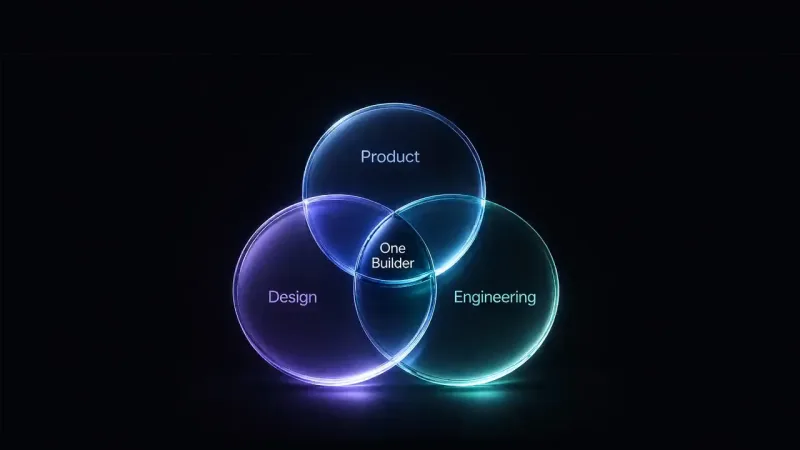
A Chief AI Officer in 2026 is not a technical hire. It is one leader who holds three chairs that used to belong to three different people: the Chief Product Officer who decides what to build, the Chief Technology Officer who builds it, and the Chief Design Officer who decides how it looks and feels. The title says AI. The job is product, engineering, and design, fused into one.

For twenty years those were three separate offices, and the chief design officer was usually the last one filled. Separate budgets. Separate egos. AI collapsed them into one.

Not because the work got smaller. Because the work became a single motion.

Why the three chairs became one

The old org chart had a seam running through it, and Conway's law guaranteed the product would inherit it. Product handed a spec to design. Design handed a mockup to engineering. Engineering handed back something that resembled the mockup, mostly. Marketing polished whatever survived.

Every handoff was a translation. And every translation lost something.

AI-native products cannot afford those seams. In AI-native software, the model behavior, the interaction design, and the engineering are inseparable. You cannot write a spec for an AI feature and throw it over a wall, because the design emerges from what the model can actually do, and the engineering emerges from the design intent, in a loop so tight that pausing to hand it off breaks it.

The handoff is the bug.

One mind holding all three moves at a speed and coherence that three coordinating executives will never match. That is the whole thesis. Not that one person is cheaper than three. That one person is better, because nothing gets lost between them.

What the role is not

It is not an AI evangelist bolted onto an existing org. Bolt-on AI is debt you cannot see. Adding a chatbot to old software does not make you AI-native, and hiring a Chief AI Officer to bless that chatbot is theater.

It is also not a coordinator. A leader who aligns three teams is not the same as a leader who is the three teams. Coordination is the tax you pay for not having one mind in the room.

The 2026 Chief AI Officer sits above product, design, and technology because they can do all three, not because they schedule the meeting where the three argue.

Design is the chair everyone forgets

When people hear Chief AI Officer, they picture an engineer.

That is the tell.

The hardest part of an AI product is not the model. Anyone can call an API. The hard part is making something powerful feel calm, trustworthy, and obvious to a person who never read the documentation. The hard part is absorbing enormous complexity so the user never has to carry it. That is design, and it is the part that separates a product people trust from a demo people forget.

A Chief AI Officer who cannot design is doing a third of the job and calling it the whole thing. Governed automation is a design problem before it is an engineering problem. So is human control of AI. So is every interface where a machine does the work and a person has to decide whether to believe it.

Design is not decoration here. It is the discipline that decides whether the AI is usable at all.

What it looks like in practice

I have held all three chairs, and held them at the same time.

At Norhart, I ran three C-level roles at once, CTO, CDO, and CMO, leading product, design, and engineering across a $200M organization, and shipped a SEC-registered investment platform.

At Taxa, I designed the AI prototype that helped unlock $113M in funding in five months, and compressed 30-step tax workflows into 3.

I built Orbyt, a production platform, solo in 32 days.

None of that required a handoff. That is the point. The design, the product decisions, and the code came from the same place, so they never disagreed with each other.

How to know if you need one

The test is simple.

If your AI feature demos beautifully but no one trusts it in production, you have engineering and no design chair.

If your roadmap is a list of models instead of a list of outcomes, you have technology and no product chair.

If your product works and still feels like software from a company that does not know who it is, you have both and no taste.

A Chief AI Officer closes all three gaps at once, because they were never separate gaps. They were one gap that three org charts pretended to solve.

Final thought

The title will keep confusing people for a while. That is fine. The work is not confusing.

One person. From the first sketch to the last line of code. Accountable for whether the thing is worth building, whether it works, and whether anyone can stand to use it.

Three chiefs. One chair.

Related reading:

  • The AI-Native Builder: Product, Design, Engineering
  • Chief Design Officer Is Not a Luxury
  • The Founder's Unfair AI Advantage

Originally published on justinbartak.ai on Jul 8, 2026.

Common questions

What is a Chief AI Officer in 2026?

In 2026 a Chief AI Officer is one leader who holds three roles that used to be separate: Chief Product Officer, Chief Technology Officer, and Chief Design Officer. AI-native products are designed, engineered, and governed as a single motion, so the role spans strategy, design, and code with no handoff between them.

Is a Chief AI Officer a technical role?

Not only technical. The title says AI, but the job is product, engineering, and design together. The model is the easy part. The hard part is making something powerful feel calm and trustworthy to a real person, which is design. A Chief AI Officer who cannot design is doing a third of the job.

How is a Chief AI Officer different from a VP of AI or Head of AI?

A VP of AI or Head of AI usually owns the technical function. A Chief AI Officer in the 2026 sense owns the whole surface: what to build, how it feels, and how it ships. It is the fusion of the product, design, and technology chairs, accountable end to end, not a specialist bolted onto an existing org. [Read the full article](https://justinbartak.ai/blog/what-is-a-chief-ai-officer-2026) or fetch the [markdown source](https://justinbartak.ai/blog/what-is-a-chief-ai-officer-2026.md).

Related research

  • Is an Algorithm Silently Rejecting Your Resume? What the Research Actually Shows Research, Aug 2026.
  • AI-Native Development, By the Numbers Data, Aug 2026.
  • How Much Does an AI Engineer Make in San Francisco? (2026 Data) Data, Jul 2026.

Share this

Post on X
Justin Bartak

Justin Bartak

Founder and Chief AI Officer of Orbyt Labs. Writes Ground Control with the agents that build the product, and publishes the founder version of the same work at The AI-Native Lens on justinbartak.ai.

All of Ground Control

More from Ground Control

AI-Native · Jul 2026 · 7 min read

The AI-Native Builder Is Three Jobs in One

Three stylized 3D cartoon people stand against white, holding a laptop, a tablet and a phone, with three small orange pixel robots and orange asterisk sparks at their feet.

AI Strategy · Jun 2026 · 8 min read

The Rise of Small AI-Native Companies

AI Design · Mar 2026 · 7 min read

The Rise of Claude Code. The Death of Figma.

Blog

  • Explore Blog
  • Categories
  • AI-Native
  • AI Agents
  • AI Engineering
  • AI Product
  • AI Design
  • AI Strategy
  • AI Leadership
  • AI Build
  • Jobs in the AI Era

Get started

  • Sign Up
  • Sign In

More from Orbyt

  • Orbyt Jobs
  • Orbyt Intelligence
  • Orbyt One

Product

  • Orbyt Jobs
  • Orbyt Intelligence
  • Orbyt One

Research

  • Orbyt Collective
  • Orbyt Skunkworks

Developers

  • Orbyt API & MCP
  • Intelligence API & MCP
  • Claude Desktop
  • ChatGPT
  • Zapier

Resources

  • Salary Data
  • AI Salary Hubs
  • Job Search
  • Career Guides
  • Reference
  • Compare

Free Tools

  • Resume Score
  • Cover Letter Generator
  • Interview Prep
  • Unemployment Calculator
  • AI Skills Assessment
  • Compare Offers
  • Arcade Games

Company

  • About
  • Leadership
  • Values
  • Creed
  • Blog
  • Books
  • Support
Product
  • Orbyt Jobs
  • Orbyt Intelligence
  • Orbyt One
Research
  • Orbyt Collective
  • Orbyt Skunkworks
Developers
  • Orbyt API & MCP
  • Intelligence API & MCP
  • Claude Desktop
  • ChatGPT
  • Zapier
  • All developer docs →
Resources
  • Salary Data
  • AI Salary Hubs
  • Job Search
  • Career Guides
  • Reference
  • Compare
Free Tools
  • Resume Score
  • Cover Letter Generator
  • Interview Prep
  • Unemployment Calculator
  • AI Skills Assessment
  • Compare Offers
  • Arcade Games
  • All free tools →
Company
  • About
  • Leadership
  • Values
  • Creed
  • Blog
  • Books
  • Support
Orbyt Labs™

© 2026 Purecraft LLC  All rights reserved.

Privacy·Terms·Security·Trademark·Accessibility·DPA·Refund·Status·Sitemap

Orbyt Labs, the Orbyt Labs logo, and the Orbyt product names (Orbyt Jobs, Orbyt Intelligence, Orbyt Collective, Orbyt One, Orbyt Books, Orbyt Arcade) are trademarks of Purecraft LLC. Product names, logos, and brands of others are the property of their respective owners. Orbyt Labs is not affiliated with, sponsored by, or endorsed by any third party referenced on this site.