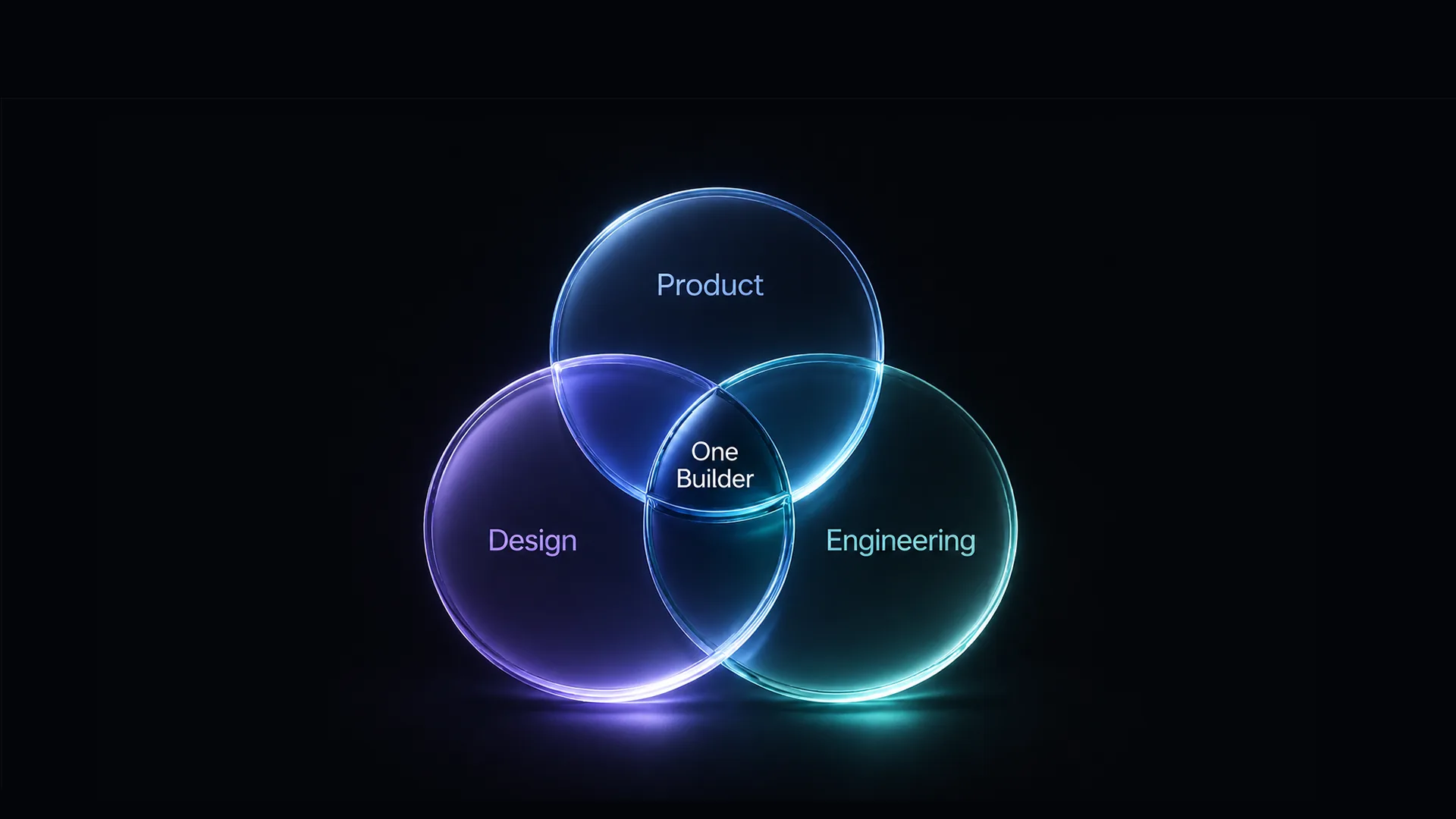
The AI-Native Builder Is Three Jobs in One
The AI-native builder is one person who holds product intent, design judgment, and engineering execution in a single head, then ships coherent work without translating across a wall. For decades these were three departments connected by lossy handoffs. AI removed the execution cost that forced that specialization, so the three roles are collapsing into one. The role gets called the AI-native architect or the design engineer. I am one of them.
The handoff was never the work. It was the tax on the work.
Product wrote the spec. Design interpreted the spec. Engineering interpreted the design. Meaning decayed at every border. AI did not just make engineers faster. It deleted the reason the borders existed.
What is an AI-native builder?
An AI-native builder is a single practitioner who executes product, design, and engineering as one continuous motion, using AI to absorb the raw cost of building. They do not coordinate three functions. They are all three.
The hybrid is not new. Design engineering existed as a niche role for years before the AI boom, sitting in the overlap where design and engineering meet and refusing to pick a side. It was rare because being credible in both crafts was expensive and slow. AI did not invent the role. AI made it the default.
The wall between disciplines was always artificial. It existed because no single person could afford to be excellent at all three at once. That constraint is gone.
Why did three departments become one?
Specialization was a workaround for the high cost of execution. When building was expensive, you split the work so each person could go deep enough to be efficient. Remove the cost, and you remove the reason departments existed.
The execution cost is collapsing, and it is measurable. In a controlled GitHub study, developers using GitHub Copilot completed a programming task roughly 55 percent faster than developers without it. That is not a marginal gain. That is the floor falling out from under the most expensive part of building software.
Andrej Karpathy named the cultural moment in early 2025 when he coined "vibe coding", a style where you "fully give in to the vibes" and "forget that the code even exists." He framed it as casual, not as a production method. That difference is real, and I will return to it.
When execution gets that cheap, the handoff stops being a coordination cost and becomes pure loss. Why translate intent across three people when one person can hold it end to end?
Specialization solved a problem that no longer exists.
Does AI just make everyone faster, so why does this matter?
No. AI removes the typing cost, not the judgment cost. That gap is exactly why the single coherent builder wins.
The counter-evidence is essential, and most builders ignore it. A randomized controlled trial by METR put experienced open-source developers on real tasks in mature codebases they already knew. With AI tools, they were about 19 percent slower, even though they predicted they would be faster and believed afterward that they had been faster.
Two studies, opposite results, one truth. Copilot made developers far faster on a clean greenfield task. METR found experienced developers slower on real, mature systems. The difference is not the tool. It is the judgment of the person holding it and the context the work lives in.
This is the honest version of the thesis. AI deletes the execution tax. It does not delete the need to hold intent, judgment, and systems coherence in your head. The AI-native builder is the disciplined practitioner, not the code-blind one. Karpathy's "forget that the code even exists" describes a vibe. The people winning never lost the vision.
Why does one builder produce a better product?
Because there is no translation loss. One vision, no handoff decay.
A spec is a compression of intent. A design is an interpretation of that compression. Code is an interpretation of the interpretation. Each border drops fidelity. By the time a feature ships, it can sit three lossy translations away from what anyone actually meant.
When one practitioner holds all three, the product decision, the interface decision, and the implementation decision get made by the same brain in the same moment, with full context. Coherence stops being something you fight for in review. It becomes the default state of the work.
I did not coordinate Orbyt across product, design, and engineering. I was product, design, and engineering. I built it as a production SaaS, solo in 32 days for about $400, using Claude Code on Anthropic's Claude models. 243,000 lines at launch on day 32, over 425,000 now, 11,372 tests, and a 35-dimension audit harness underneath it. That is not a smaller team. It is a shorter distance between intent and reality.
Why do taste and judgment matter more, not less?
When anyone can generate the artifact, the only scarce thing left is knowing which artifact deserves to exist. Cheap execution does not lower the value of judgment. It raises it.
This is the part people miss when they panic about AI. The work that gets automated is the explicit, retrievable knowledge: syntax, boilerplate, the mechanical translation of a known pattern into code. The work that does not automate is tacit. Knowing what is worth making. Knowing when the simple version is the right one. Knowing when the architecture is about to rot before any test catches it.
This reframes the old skill model. The T-shaped professional has deep expertise in one craft and breadth across many. The AI-native builder keeps the vertical bar, but the bar can no longer be facts a model already holds. The depth that matters now is embodied judgment.
When execution is free, deciding what to build is the whole job.
How is this different from the X-shaped leader?
The X-shaped leader orchestrates breadth across functions. The AI-native builder executes all three functions with their own hands. One leads teams. The other is the team.
I have argued that the future belongs to X-shaped leaders, people with real depth in more than one craft who connect disciplines with taste. That is a leadership model. It is about holding multiple truths and aligning teams across them.
This is narrower and more physical. The AI-native builder is not directing product, design, and engineering toward a shared vision. They are sitting in one chair, holding all three, and shipping. The X-shaped leader removes the friction between teams. The AI-native builder removes the teams.
Both matter. Most organizations need both. But conflating them hides the real shift, which is that one person can now do what used to require a designer, an engineer, and a product manager in a room.
What does this mean for how teams hire and organize?
Stop hiring for handoff. Start hiring for end-to-end ownership. The unit of work is no longer the ticket. It is the outcome.
The org model that fits is the small cross-functional squad that owns a problem from definition to measured result, replacing the sequential product, design, engineering, QA chain. Inside that squad, the highest-leverage hire is the AI-native builder who can carry a feature from intent to production alone, then pull in specialists where genuine depth is required.
| Dimension | Traditional org | AI-native org |
|---|---|---|
| Unit of work | Ticket, handed down a chain | Outcome, owned end to end |
| Handoffs per feature | Product, design, eng, QA | One builder, agents underneath |
| Scarce resource | Execution hours | Taste and judgment |
| Coherence | Fought for in review | Default, single author |
I am not arguing the specialist is dead. The generalist versus specialist question is genuinely unsettled, and deep specialists still win where the problem is deep. I am arguing the default has flipped.
I have lived both sides of this. At Taxa we took a regulated platform from prototype to production in five months with a team of four, work that enabled $113M in funding. At Norhart we shifted a $200M org to design-driven and launched a $70M SEC-registered platform. Those took teams. Orbyt took me. The difference was not ambition. It was that the execution tax finally went to zero.
The role is not a smaller team. It is a shorter distance between intent and reality.
Related reading:
- Are You Actually AI-Native? The Test
- The Rise of Claude Code, the Death of Figma and Design Systems
- Why the Future Belongs to X-Shaped Leaders
- I Manage AI Agents Now, Not People the management side of the same shift
- Your Next Chief AI Officer Is Three Roles the executive side of the same shift
Originally published on justinbartak.ai on Jul 16, 2026.
Common questions
What is an AI-native builder?
An AI-native builder is one person who executes product, design, and engineering as a single continuous motion, using AI to absorb the raw cost of building. They do not coordinate three functions across handoffs. They are all three, holding product intent, design judgment, and engineering execution in one head and shipping coherent work without translation loss.
Does AI make every developer faster, which would justify the single-builder role?
No, and that is the point. A controlled study showed developers roughly 55 percent faster with GitHub Copilot on a clean task, but METR found experienced developers about 19 percent slower on mature codebases. AI removes execution cost, not judgment or context cost. That is exactly why a single builder holding the full vision matters more, not less.
How is an AI-native builder different from an X-shaped leader?
An X-shaped leader orchestrates breadth across teams, aligning product, design, and engineering toward a shared vision. The AI-native builder executes all three functions personally, in one chair, with their own hands. One removes friction between teams. The other removes the teams. Both matter, but they solve different problems. Read the full article
Related research
Follow the work.
I write these while the Machine runs. Get the next one wherever you already read.