The Rise of Small AI-Native Companies
The next wave of disruption is not coming from a unicorn with 500 engineers. It is coming from a team of one to ten people who are AI-native, who ship in days what incumbents schedule in quarters, and who carry almost no fixed cost while they do it.
I know this because I am one of them.
I built Orbyt, a production SaaS, solo in 32 days for about $400, using Claude Code. 243,000 lines at launch on day 32. Over 425,000 now. 11,372 tests. A 35-dimension audit harness underneath it. That is not a prototype. That is a shipped product with paying customers, and it was built by one person and a set of agents.
The 1-to-10 person company can now build what used to take 50. That is the whole thesis, and it is already true.
What does a small AI-native company actually do differently?
It treats AI as the foundation, not a feature. The team is small on purpose, because every additional person adds coordination cost and subtracts speed. The leverage comes from agents, not headcount.
The traditional startup spends its first year hiring. It recruits a founding engineer, then two, then a designer, then a head of product. Each hire is a bet, a salary, and three months of ramp. The AI-native company spends its first month shipping.
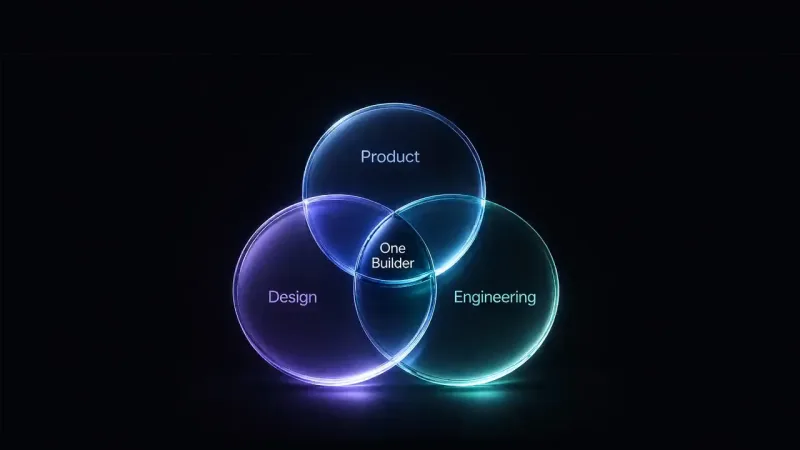
I did not write a Figma file and hand it to an engineer. I described the product to an agent and watched it become code. The handoff that eats half a normal company's calendar simply did not exist. Claude Code collapsed design and build into one motion.
The small AI-native team optimizes for one thing the incumbent cannot: the distance between an idea and a shipped change. For me that distance is a sentence and a test run. No ticket, no standup, no sprint board, no waiting on a teammate's branch. The idea exists in the morning and runs in production by lunch.
Why can't incumbents just respond?
Because the thing slowing them down is not talent. It is structure. And structure does not respond to a memo.
A 200-person org has a roadmap, a quarterly planning cycle, a design system review, a security gate, a legal review, and a release train. Each one exists for a good reason. Together they mean a single feature touches a dozen calendars before it ships. You cannot delete that machinery in a quarter. It is the company.
I watched this from the inside. At Norhart we shifted a $200M org to design-driven and launched a $70M SEC-registered investment platform. Good work, real outcomes, and it moved at the speed a regulated 200-person company moves. That is the ceiling. The ceiling is structural.
The incumbent's advantage is distribution, brand, and capital. Its disadvantage is that every one of those assets is wrapped in process. The AI-native team has none of the assets and none of the process. In a market where speed compounds, the second condition wins more often than anyone expects.
There is a deeper trap here. The incumbent can buy AI tools, mandate them, and run an all-hands about being AI-first. The tools still land on top of the same approval chain. Bolt-on AI speeds up the typing and leaves the coordination untouched. The constraint was never how fast anyone typed.
Incumbents cannot out-ship a team that has no meetings.
The economics are the real story
A small AI-native company has almost no fixed cost. That changes what is fundable, what is survivable, and who gets to play.
Orbyt's 32-day build cost about $400 in model usage. Not $400,000. Not a seed round. Four hundred dollars. The product runs on Anthropic's Claude models, serving customers on Sonnet 4.5 as the default, with Haiku 4.5, Opus 4.6, and Opus 4.7 available. The cost of building dropped by orders of magnitude, and it keeps dropping.
Compare the structure of the two companies.
| Dimension | Incumbent (50+) | AI-native (1 to 10) |
|---|---|---|
| Cost to ship v1 | Millions, plus a year | Hundreds, plus weeks |
| Coordination overhead | Dozens of calendars | One operator, many agents |
| Idea to shipped change | A quarter | A day |
| Burn while iterating | Payroll | Token usage |
When fixed cost approaches zero, the math of risk inverts. A failed experiment at an incumbent burned a team for two quarters. A failed experiment for the AI-native team burned a weekend and a few dollars. So the small team runs more experiments, learns faster, and finds the winner before the incumbent has finished planning the kickoff.
Look at what each side actually spends to learn the same lesson. The incumbent funds a squad, a planning offsite, and two quarters of payroll to validate one bet. The AI-native operator spends a weekend and pocket change to validate ten. Failure stops being expensive, so it stops being scary, and the team that is not scared of failing iterates its way to the answer first.
This is why the bottleneck was never the code. The bottleneck was always the cost of coordination, and AI-native teams refuse to pay it.
The new constraint is judgment, not labor
When one person can produce the output of fifty, the scarce resource is no longer engineering hours. It is taste, judgment, and direction.
Agents will build whatever you point them at. They do not tell you what is worth building. They do not know when a feature is wrong, when the architecture is about to rot, or when the simplest version is the right one. That decision still belongs to a human, and it is the entire game.
This is the founder's actual edge now. Not the ability to write code. The ability to know which code matters. Judgment is the moat, and it is the one input agents cannot supply.
The small AI-native team wins when the operator has deep judgment and loses when they do not. I shipped Orbyt fast because I have spent a career deciding what to build. Taxa, where we took a prototype to production in 5 months and enabled $113M in funding with a team of four. Gro CRM, where we reimagined the CRM as an operating system. Ntractive, recognized by Apple at WWDC and demoed in Apple Stores worldwide. The agents are new. The judgment is not.
This reframes who a small AI-native company should hire. Not ten generalists to share the load. One or two operators with strong taste, each commanding agents, each accountable for outcomes rather than tickets. The org chart flattens because the work that used to require a chart now runs through one head and a fleet of agents.
Agents removed the labor constraint. They sharpened the judgment constraint.
What this means for markets
Disruption is about to get faster, cheaper, and harder to see coming. The next competitor in your category may not exist yet, and when it appears it may be one person.
Expect more categories to be attacked by teams too small to register on your competitive radar. They will not file for a Series A. They will not hire a sales team before they have a product. They will ship, find ten customers, ship again, and be at a hundred before procurement at the incumbent has approved a response.
Expect the value of a large engineering org to be questioned, hard, by boards who have watched a solo founder match its output. Headcount used to be a proxy for capability. It is becoming a proxy for overhead.
And expect the durable advantage to move. Distribution and brand still matter. But the new moat is being AI-native at the foundation, because a company built that way compounds speed every quarter while a bolt-on competitor compounds debt.
If you run an incumbent, the response is not a committee. It is a small team carved out of the org chart, handed agents, freed from the approval machinery, and measured on shipped change instead of activity. Treat it like a competitor you are funding before someone else does. The alternative is meeting that competitor in your own market in eighteen months, except they will own it.
The companies most at risk are the ones that read this and respond by forming a committee.
The moral: the smallest team in your market is now the one that can move fastest, and speed is the only advantage that compounds.
Related reading:
- I Built a Production SaaS in 32 Days
- The Bottleneck Was Never the Code
- AI-Native Is the Moat
- Using Claude Code Is Like No One Ever Saying No to You what removing the gatekeepers actually unlocks
- My C-Suite of Agents Named Themselves. what the small AI-native company's org chart actually looks like
- I Ran 830 Agents in One Long Horizon Session. the speed advantage, counted in agents per session
Originally published on justinbartak.ai on Jun 23, 2026.
Common questions
What is a small AI-native company?
A small AI-native company is a one to ten person team that treats AI as the foundation of how it builds, not a bolt-on feature. Agents do the labor, so a tiny team produces the output of fifty. Orbyt is an example: a production SaaS built solo in 32 days for about $400.
Why can't large incumbents respond to small AI-native startups?
Incumbents are slowed by structure, not talent. A 200-person org runs planning cycles, design reviews, security gates, and release trains, so one feature touches a dozen calendars before shipping. That machinery cannot be deleted in a quarter, because it is the company. AI-native teams carry none of that process and out-ship them.
What is the real advantage of an AI-native startup?
Near-zero fixed cost and near-zero coordination overhead. Building Orbyt cost about $400 instead of millions, and the distance from idea to shipped change is a day, not a quarter. When fixed cost approaches zero, the team runs more experiments, learns faster, and finds the winner before incumbents finish planning. Read the full article
Related research
Follow the work.
I write these while the Machine runs. Get the next one wherever you already read.