Claude Code Is Like No One Saying No to You
The real unlock of Claude Code is not speed. It is the disappearance of the word "no."
For twenty years, every idea I had hit a wall. No budget this quarter. No engineering capacity. No room in the sprint. No designer free until March. No time. The idea was rarely the problem. The gatekeeper was. And the gatekeeper always won.
The gatekeepers are gone.
When nothing can tell you no, the only thing standing between an idea and production is whether the idea was any good.
That sounds like a gift. It is also the most dangerous thing that has happened to product builders in a decade. The "no" was never just friction. It was a filter. Remove a filter and you do not just get more of the good. You get more of everything.
What the "no" used to be
The "no" was a system of throttles, and most of us never named it.
Budget was a throttle. You could not staff what you could not fund. Capacity was a throttle. Six engineers ship six engineers' worth of work, no matter how big the vision. The sprint was a throttle. A two week box that forced you to cut the idea down to what fit. The org chart was a throttle. Design lived over there, backend over here, and the handoff cost a week.
Each throttle felt like a constraint. Each one was secretly doing a second job.
It was killing bad ideas before they cost anything.
A feature that was not worth a quarter of engineering time died in the planning meeting. A redesign nobody could justify never got staffed. The expensive ones got challenged. The unfundable ones got shelved. The "no" was the cheapest quality control any company ever had, and it ran for free.
Scarcity was doing the editing. We just thought it was getting in the way.
What happens when nothing says no
I built Orbyt solo in 32 days. 243,000 lines of code at launch. 4,124 tests and 852 commits on day 32. It is over 425,000 lines now, with 11,372 tests. It cost about $400 in model spend.
There was no sprint to fit inside. No backlog grooming. No capacity meeting. When I wanted a feature, I did not ask whether there was room for it. I built it. When I wanted to rip out an architecture decision and redo it, I did not weigh it against three other priorities. I just did it.
The first thing you feel is exhilaration. Twenty years of "not this quarter" evaporate in a week. You ship the thing you always wanted to ship. Then the thing after that. Then a thing you would never have proposed in a planning meeting because it was too speculative to justify.
The second thing you feel is the absence of the filter.
Every idea now ships at roughly the same cost. The brilliant one and the mediocre one both take an afternoon. The "no" that used to separate them is gone. So scope creeps, because nothing checks it. Surface area explodes, because every "what if" is now answerable in an hour. You build features you do not need because you can, not because you should.
The bottleneck moved. It was never the code. Remove the constraint on production and you do not remove the need for a constraint. You relocate it. And if you do not consciously rebuild it, it relocates to the worst possible place: nowhere.
When no one says no, you have to be the no
Here is the uncomfortable part. The gatekeepers were doing your judgment for you. Now you have to do it yourself, deliberately, on every decision, with nothing pushing back.
That is harder than it sounds. The instinct that says "let's just see if this works" used to be expensive enough to suppress. Now it is free. You have to supply the discipline that scarcity used to supply, and you have to do it while a tireless agent offers to build literally anything you describe.
The "no" has to come from somewhere. There are exactly three places it can come from now.
Your taste has to be the no. The hardest editing is the feature you can build and choose not to. Judgment is the unfair advantage now, not the ability to execute. When execution is free, the entire value of a builder collapses into knowing what is worth executing. Taste was always the moat. Agentic coding just removed everything that used to hide that fact.
Your architecture has to be the no. An AI-native foundation says no to the things that would rot the system, by making the right path the easy one and the wrong path the painful one. Without that, infinite build speed just means infinite mess, faster.
Your test suite has to be the no. This is the one most people skip, and it is the one that actually saves you.
The test suite is the new gatekeeper
I cannot read my own codebase anymore. Over 425,000 lines. No human reviews that line by line, and I do not pretend to. I ship to it daily anyway.
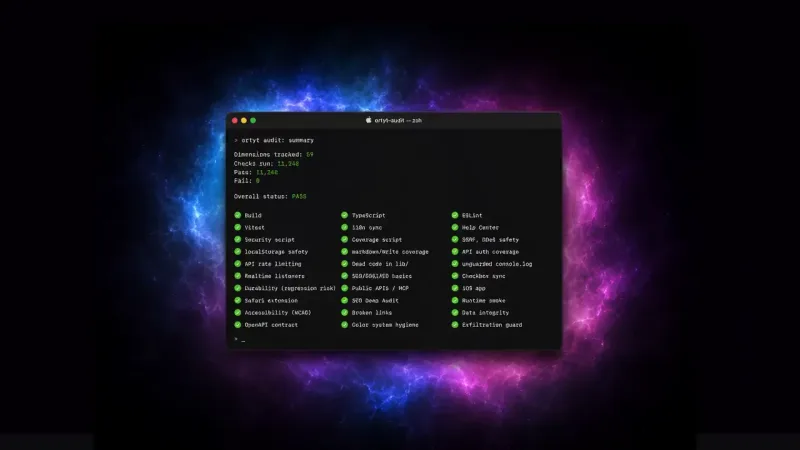
The only reason that is sane is the verification layer. 11,372 tests. A 35-dimension audit harness that grades build, types, lint, locales, security, and accessibility before anything goes near production. The agent can write anything. The harness decides what survives.
That harness is the new "no." It is the one gatekeeper I rebuilt on purpose, because I removed all the others.
This is the operator-plus-agents model in one sentence: the agent says yes to everything, and the system you built around it says no to what should not exist. One operator, a stack of agents, and a verification layer with veto power. The agent proposes. The harness disposes. My judgment sits above both, deciding what to even ask for.
Remove the human gatekeepers and you must promote the automated ones, or you are flying with no instruments at full speed.
The model itself I treat as swappable. Orbyt serves customers on Sonnet 4.5 by default, with Haiku 4.5, Opus 4.6, and Opus 4.7 available. I have swapped frontier models mid-session while building. Nothing broke, because the context lived in the tests and the docs, not in the model. The verification layer is the permanent thing. The model is rented.
What this means if you run a team
The old playbook treated engineering capacity as the scarce resource. You hired against it, planned around it, and used it as the natural "no" on everything that did not make the cut.
That resource is no longer scarce. Which means it is no longer your filter.
Remove the engineering bottleneck without installing a new gatekeeper and you do not get a more productive team. You get a faster mess. Your people will build more, and a larger fraction of what they build will be things nobody needed, shipped to a system nobody can fully verify.
The leadership job inverts. It used to be about allocating scarce build capacity. Now it is about supplying the "no" that scarcity used to supply for free. That means investing in taste, in architecture, and in verification with the same seriousness you once invested in hiring engineers. Those three are your new throttles. They are the only ones you have left.
The companies that win the next five years will not be the ones who can build the most. Everyone can build everything now. The winners will be the ones who got disciplined about what they refuse to build, and who made their test suite strict enough to enforce it.
The moral is short.
When no one can say no to you, your judgment and your tests have to.
See this in practice: Orbyt, built solo in 32 days, the first product out of Purecraft.
Related reading:
- I Cannot Read My Own Codebase. I Ship to It Daily.
- The Bottleneck Was Never the Code
- The Founder's Unfair AI Advantage
Originally published on justinbartak.ai on Jun 16, 2026.
Common questions
What is the real advantage of using Claude Code?
The real advantage of Claude Code is not raw speed. It is that the old constraints disappear. No budget gate, no engineering capacity limit, no sprint to fit inside, no waiting for a free designer. When nothing can tell an idea no, the only remaining filter is whether the idea was worth building.
If AI removes the engineering bottleneck, what becomes the new constraint?
Verification becomes the new constraint. When an agent can build anything, the bottleneck moves to deciding what should exist and confirming it works. On Orbyt that means 11,372 tests and a 35-dimension audit harness. The agent proposes, the harness disposes, and human judgment decides what to ask for.
Why does removing the engineering bottleneck create risk?
Because scarcity was secretly doing quality control. Budget, capacity, and sprint limits killed weak ideas before they cost anything. Remove those gates without installing new ones and you do not get a more productive team. You get a faster mess. Taste, architecture, and a strict test suite must become the new no. Read the full article
Related research
Follow the work.
I write these while the Machine runs. Get the next one wherever you already read.