The Fable the Government Erased
Did the US government just ban a frontier AI model? Yes. On June 12, 2026, citing national security authorities, the government issued an export control directive that forced Anthropic to suspend all access to Claude Fable 5 and Mythos 5 for every customer overnight, with no migration window. I switched back to Opus 4.8 the same day and kept shipping Orbyt. Nothing broke.
The most capable model the public could buy did not get deprecated. It got export-controlled out of existence, mid-prompt.
This is the sequel to Every Fable Has a Moral. Mine Has Data. That article's moral was "Budget for the harness. Rent the model." Three days later the universe stress-tested it at the highest possible stakes.
What the terminal said when the model died
I was mid-prompt in a live Claude Code session on June 12. The work stopped and the terminal returned one line.
There's an issue with the selected model (claude-fable-5). It may not exist or you may not have access to it. Run /model to pick a different model.
"It may not exist." That was the gut punch. Three days of June had been written on this model. It was gone.
The notice, verbatim
Then Anthropic published the reason. The language is the story, so here it is in full.
The US government, citing national security authorities, has issued an export control directive to suspend all access to Fable 5 and Mythos 5 by any foreign national, whether inside or outside the United States, including foreign national Anthropic employees. The net effect of this order is that we must abruptly disable Fable 5 and Mythos 5 for all our customers to ensure compliance. Access to all other Anthropic models will not be affected.
Fable 5 and Mythos 5 went dark for everyone on earth, overnight. Claude Opus 4.8, Sonnet, and Haiku kept working. No notice. No sunset. No grandfather clause.
The June 9 swap was the rehearsal. June 12 was the real thing.
Three days earlier, on June 9, I switched to Fable 5 by choice, in the middle of a live session, with no migration plan. That was the voluntary swap the prior article documented. June 12 was the involuntary one. Same outcome both times. The codebase, the tests, the docs, and the project log carried context across a government shutdown exactly as they had across my own decision.
Why the shutdown was a footnote, not a failure
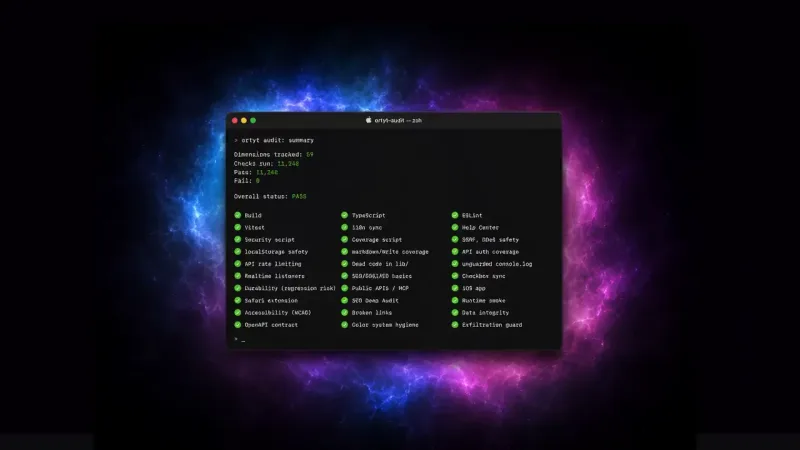
Because the context never lived in the model. It lived in the system. Orbyt carries 11,372 tests and a 35-dimension audit harness, plus a project log either model picks up cold. The model that finished three days of my June stopped existing for every customer of every company at once, and the only thing in my world that noticed was a line in a procurement log.
I ran the switch, picked Opus 4.8, and shipped the same afternoon. No lost work. No outage. No scramble. The mechanics of that verification layer are in I Cannot Read My Own Codebase. I Ship to It Daily.
The harness is what made the model swappable. Swappability is what made the export control survivable.
Frontier models are now dual-use, national-security-controlled assets
This changes the category of risk. Frontier AI is no longer just commercial software. The US government now treats the most powerful models the way it treats advanced chips and other sensitive dual-use technology: as items with both civilian and national-security application, subject to export control.
That is not speculation. The Bureau of Industry and Security, inside the Commerce Department, administers the Export Administration Regulations and the Commerce Control List for dual-use items. The Export Control Reform Act of 2018 directs it to control emerging and foundational technologies critical to national security. In January 2025, that regime reached AI directly for the first time, placing controls on the unpublished weights of the most advanced closed-weight models under a new classification. That specific rule was rescinded in May 2025 and is being replaced, so the regime is evolving. The direction of travel is not.
Watch which models stayed on. The controls hit the very top of the capability curve, which is exactly where US policy has aimed since 2022.
Buy at that altitude and you buy the regulatory exposure with it.
What "deemed export" means for the model in your terminal
Here is the quiet mechanism most executives miss. Under the Export Administration Regulations, a "deemed export" means releasing controlled technology to a foreign national, even your own employee, even inside your own US office, can count as an export to that person's home country. Lawful permanent residents, US citizens, and protected individuals are exempt, as are fundamental research and publicly available information. The Anthropic notice mirrors that exact logic: access suspended for "any foreign national, whether inside or outside the United States."
I am labeling the next part as analysis, not settled law. Whether and how the deemed-export rule applies to cloud API access to a frontier model is a genuinely novel question, not established doctrine, and whether model outputs are themselves controlled is an open policy vacuum. Honesty first, because the legal frontier here is being drawn in real time.
What is settled enough for a board: a government action you cannot influence can dark your model overnight, with no notice and no carve-out for your business.
Vendor risk versus political risk
A vendor can deprecate a model. You get a sunset date, a migration guide, a successor. A government can recall one. You get a line in a terminal.
If your business depends on a single model, you do not have a vendor risk. You have a political risk.
Political risk does not respect your roadmap. It moves at the speed of a directive, not a deprecation schedule. Export controls can be imposed through interim rules and emergency authorities, sometimes with no phased transition for the companies they hit. Single-model dependency is now a single point of geopolitical failure, and the question for any board is no longer "is this model good enough?" It is "what happens to our product the morning this model is gone, by law, with no notice?"
The product was never exposed, because the architecture never depended on one model
Here is the part that proves the design. Orbyt serves its customers on Sonnet 4.5 as the default, plus Haiku 4.5, Opus 4.6, and Opus 4.7. Neither frontier model is served to customers at all. Fable 5 and Opus 4.8 only ever appeared as the builder, never as the product.
So when Fable 5 was export-controlled out of existence, zero customers were affected. Not because I got lucky. Because the architecture was model-agnostic by design, and the only genuine reference to "fable" anywhere in the Orbyt codebase was a guard regex on model IDs. That is the correct amount of dependency. Enough to validate, not enough to depend.
Model-agnostic architecture is now a national-security risk control, not just an engineering preference.
The operator playbook: what carried the context
Strip the philosophy out, and here is what a founder or CTO can copy. This is what turned a national-security shutdown into a one-line procurement event.
Build the verification layer first. Tests are the thing that survives the model. 11,372 of them mean any model's output gets graded against the same bar, so a swap cannot quietly lower quality. The 35-dimension audit harness scores quality on demand, so "is the new model holding the line?" is a command, not a vibe.
Keep the context in the repo, never in the chat. The project log, the docs, and the spec history let a cold model resume mid-thought. If your institutional memory lives in one model's conversation, that memory is hostage to that model's availability.
Keep a fallback model qualified, not theoretical. I did not discover on June 12 whether Opus 4.8 could carry the work. I already knew, because the harness had run against both. A fallback you have never tested is a wish, not a plan.
What to do if your business runs on one model
Stop asking whether the model is good enough. Start asking what happens to your product the morning that model is gone, by law, with no notice. If the answer is "we go down," your moat is rented from a vendor who is now rented from a regulator.
Notice the irony in the economics too. Fable 5 listed at $10 per million input tokens and $50 per million output, double Opus 4.8 at $5 and $25, on list-price arithmetic from my transcripts, not billing data. The premium tier was also the one most exposed to export control. The most expensive model to rent became the most expensive to depend on. The full field manual on model selection lives on Orbyt's AI Skills Lab, Claude Fable 5 Shipped. Here's What Changes in Claude Code. This is also why every product out of Purecraft is built model-agnostic by default.
Budget for the harness. Rent the model.
The moral
Orbyt was 243,000 lines of code the day it launched, day 32, built solo. It is over 425,000 now. The model that wrote three days of my June stopped existing for everyone on earth at the same minute, by order of a government, with no notice, and the only thing that noticed, anywhere in my stack, was a single line in a procurement log.
The first fable's moral held. This one earned its escalation.
Models can be recalled. The system cannot.
Related reading:
- Every Fable Has a Moral. Mine Has Data. the prequel, with the full Opus 4.8 versus Fable 5 data
- Claude Fable 5 Shipped. Here's What Changes in Claude Code. on Orbyt's AI Skills Lab
- I Cannot Read My Own Codebase. I Ship to It Daily.
- I Run a Stack of Terminals. The Bottleneck Was Never the Code.
- Kimi K3 vs Fable 5: The Open Frontier the sequel's sequel: an open-weight frontier no directive can recall
- I Bet My Company on AI. Safety Is Why. the safety finding behind this shutdown, taken seriously
Originally published on justinbartak.ai on Jun 12, 2026.
Common questions
Did the US government ban Claude Fable 5?
Yes. On June 12, 2026, the US government, citing national security authorities, issued an export control directive ordering Anthropic to suspend all access to Fable 5 and Mythos 5 for any foreign national, inside or outside the United States. To comply, Anthropic disabled both models for every customer overnight. All other Anthropic models kept working.
Why was Claude Fable 5 export-controlled?
The US government now treats frontier AI as dual-use, national-security-sensitive technology, meaning it has both civilian and military uses. The directive reached foreign nationals through deemed-export logic, which restricts access even on US soil. Model access is therefore a political and regulatory risk, not just a vendor risk, and political risk arrives without a migration window.
What happens when the AI model you depend on gets shut down?
If your architecture treats the model as a swappable component, almost nothing happens. When Fable 5 went dark mid-prompt, I switched back to Opus 4.8 the same day and kept shipping Orbyt. The context lived in the repo: over 11,000 tests, a 35-dimension audit harness, and a project log either model could resume cold. Read the full article
Related research
- Long Horizon Agents Don't Fail. They Pass. Aug 2026.
- Every Fable Has a Moral. Mine Has Data. Jun 2026.
- Governing an agent leadership team Sep 2026.
Follow the work.
I write these while the Machine runs. Get the next one wherever you already read.