Average Is Free. Build Best-in-Class.
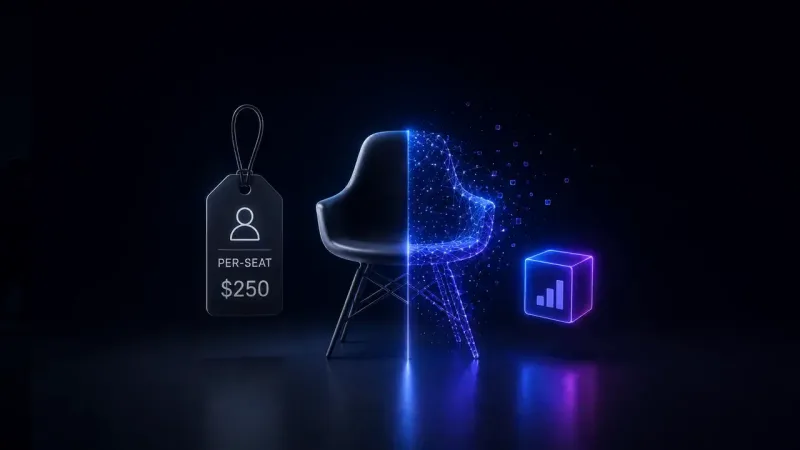
Average is now free. AI drove the marginal cost of competent to near zero, so a passable product is something anyone can generate in an afternoon. Free supply is worthless supply. The only product still worth shipping is best-in-class, and best-in-class is not a feeling. It is a price.
The price is the point of this essay.
Shipping an average product in 2026 is economically identical to not shipping. You spent the money. You spent the months. And you arrived at a thing the market already has in infinite quantity, at zero cost, on demand. You did not enter the market. You added to the commodity pool.
The middle is being deleted
For most of software history, there were three tiers. Best-in-class at the top. Free or broken at the bottom. And a vast, profitable middle where most companies lived. Decent products, sold at decent prices, to customers who had no better option in their budget.
That middle was a moat made of effort. Building something competent took real engineering, real time, real money. The cost of competent was the barrier to entry, and the barrier was the business.
AI removed the barrier.
Competent is now the floor, generated on demand, priced at zero. The middle did not get more competitive. It got commoditized. There is no longer a defensible position between best-in-class and free, because everything that used to be defensible about the middle was its cost of production, and that cost just collapsed.
So the market is splitting into two states. Best-in-class. And free.
There is no middle to sell into anymore.
This is why "good enough" is now a strategy that loses money. Not because good enough is lazy. Because good enough is the exact thing the market now produces for nothing.
Best-in-class is a market position, not a vibe
When the middle disappears, best-in-class stops being a quality aspiration and becomes the only defensible category left. It is the position. It is the moat.
Look at where durable value actually concentrates. Apple does not win because it has more features. It wins because the hardware, the software, and the retail experience are one continuous object. You buy a phone, set it up, and it pairs with the watch you bought two years ago without a single configuration screen. That coherence is not a marketing claim. It is an operating model that almost no company is structured to copy.
Stripe does not win on payment rails. The rails are a commodity. It wins because a developer can read the docs, copy seven lines, and have money moving in an afternoon, with error messages that tell you exactly what went wrong and exactly how to fix it. The error message is the product. The documentation is the product. The thing nobody is paid to obsess over is the thing they obsessed over.
That is the bar. Not the brand. The behavior.
Both companies make the same wager. Be the best-in-class option, charge accordingly, and let the entire commodity middle fight over scraps below you. When the middle had cost-based protection, that wager was optional. Now it is the only game on the board.
What best-in-class actually costs
Here is what most people miss when they admire Apple and Stripe. The craft is not the expensive part. The craft is the visible part. The expensive part is everything you never see.
It is the feature that worked, shipped, demoed well, and got cut anyway because it muddied the spine. It is the launch slipped a quarter because the empty state felt cheap. It is the senior engineer spending two days on an error message that 90 percent of users will never read.
None of that shows up in a feature comparison. All of it shows up in whether the product feels inevitable or feels assembled.
Best-in-class is an accumulation of decisions nobody is paid to notice. A loading state that holds attention instead of breaking it. A default that is correct so the user never opens settings. A transition that lands at the exact weight the moment wants. Each one is a small expense. Each one is invisible. The sum is the entire difference between a product people tolerate and a product people trust.
You cannot buy that in bulk. You cannot generate it in an afternoon. That is precisely why it is worth money now.
The cheap part of your product is the part AI can make for free. The expensive part is the part that requires a person to refuse to ship until it is right. The economics inverted. The unglamorous detail used to be a cost center. Now it is the only thing on the balance sheet that the market cannot reproduce for nothing.
I have built to a bar, twice
This is not theory I admire from across the room. It is how I work.
At Taxa, we reimagined professional tax from first principles. A team of four. We took it from prototype to production in five months, and the platform enabled 113 million dollars in funding before its acquisition by Aiwyn. Tax software is a category drowning in adequate. Adequate is exactly why incumbents are vulnerable. We did not win by adding more. We won by building one thing to a standard the category had stopped believing was possible.
Orbyt, the first product out of Purecraft, is an AI-native job search platform I built solo in thirty-two days for roughly 400 dollars. 243,000 lines of code. 4,124 tests at launch. The number that matters in that list is the last one. Four thousand tests is not a flex about volume. It is the cost of refusing to ship something that breaks in a way a user would feel. The tests are the unglamorous detail. They are invisible. They are the budget line that buys the right to call something best-in-class.
AI made it possible to build that much, that fast, for that little. AI did not make it good. The bar did.
Why most companies structurally cannot
Best-in-class is not held back by talent. It is held back by structure. Most organizations are built to produce the middle, and the middle no longer exists to sell into.
The middle is what you get when every team adds its piece, every stakeholder gets a request honored, and nobody owns the right to say no at the portfolio level. That process does not produce best-in-class. It produces a competent average, which is now the thing the market gives away for free.
Best-in-class requires saying no upstream of the product, at the level of what you choose to build at all. Fewer products, built to a higher standard, beats more products built to the floor. Apple ships a handful of things a year. Stripe is famous for what it declines to do. Restraint at the portfolio level is the expense most companies will not pay, because it means killing roadmaps that already have champions and headcount.
The companies that survive the deletion of the middle will be the ones that stop measuring output and start measuring whether each thing they shipped was the best version that exists.
Average is free. The market will not pay you for a thing it can make itself at no cost. It will only pay for the thing it cannot reproduce.
Build that thing, or build nothing.
See this in practice: Orbyt, built solo in 32 days and Taxa AI-native platform.
Related reading: AI Will Commoditize Everything Except Taste, MVPs Are Lazy. Build the Real Thing, and Everyone Says AI-Native. Almost No One Is. That's the Moat..
Originally published on justinbartak.ai on Jun 1, 2026.
Common questions
Why is shipping an average product no longer a viable business strategy in 2026?
AI drove the marginal cost of competent to near zero. A passable product is something anyone can generate in an afternoon, so average is now free, and free supply is worthless supply. Shipping average is economically identical to not shipping. You added to the commodity pool instead of entering the market.
What actually makes a product best-in-class, and why is it so expensive to build?
Best-in-class is an accumulation of decisions nobody is paid to notice. The correct default, the loading state that holds attention, the error message a senior engineer spends two days on. The craft is the visible part. The expensive part is everything you never see. You cannot generate it in an afternoon.
Why can't most companies build best-in-class products even with talented teams?
It is held back by structure, not talent. Most organizations are built to produce the middle, where every team adds its piece and nobody owns the right to say no at the portfolio level. Best-in-class requires restraint upstream. Fewer products, built higher, beats more products built to the floor. Read the full article
Related research
Follow the work.
I write these while the Machine runs. Get the next one wherever you already read.