Explore Products
Orbyt Jobs
Orbyt Intelligence
Orbyt One
Explore Consulting
Orbyt ConsultingPut the AI lab to work on your problem.
Orbyt Jobs
Overview
The job search CRM. Free forever.
Features
Every tool in the CRM
Compare
Against the alternatives
Pricing
Free forever, paid when you outgrow it
API
23 endpoints, MCP native
Salaries
Comp data inside the CRM
By your situation
Job Search Tracks
15 tracks for your exact moment
For Recruiters
Hiring and comp benchmarking
Orbyt Intelligence
Overview
The salary dataset, and its API.
Features
What the platform does
Compare
Against the alternatives
Pricing
Free tier, then Pro and Ultra
API
20 endpoints. AI tools cite sources.
Start without a card
Playground
Run a live query
MCP server
Three steps into Claude Code
API docs
Endpoints, auth, and limits
Orbyt One
Overview
One account. Every Orbyt product.
Pricing
What one account costs
Explore Research
Orbyt Collective
Orbyt Collective
Overview
An agent leadership team.
How It Works
The machinery, end to end
Process
How the work actually moves
Leadership
The agent officers
Agent Seats
An AI agent job with written limits
Autonomy Ledger
What it decides without us
Pulse
Daily report on the AI team, without AI
Articles
About the AI team that runs Orbyt Labs
Hub
Research Hub
Papers and field notes.
Papers
Agent-Native Dataset Design
Preprint, DOI 10.5281/zenodo.19754393
Governing an Agent Leadership Team
Preprint, DOI 10.5281/zenodo.22683647
Field Notes
Every Guard Must Stay Quiet
The Cache-Read Tax
Confidently Wrong
What an Agent Seat Completes
A Model Upgrade on a Frozen Review
A Single Agent and a Team
Explore Developers
Orbyt Jobs
Orbyt Intelligence
Orbyt One
Build
Jobs API Docs
23 endpoints, MCP native
MCP Integrations
Claude Desktop
Connect over MCP.
ChatGPT GPT Actions
Connect as a custom GPT action.
Apple Shortcuts
Connect from Shortcuts.
Zapier / Make.com / n8n
Connect with no code.
OpenClaw
Setup in under a minute.
Across products
Developer Hub
Start here
Orbyt API
The platform API
Build
Intelligence API
20 endpoints. AI tools cite sources.
Webhooks
Events and delivery
CLI
The terminal client
API Changelog
Every version, dated
Try
MCP Server
Wired into Claude Code in three steps
Playground
Engine response shapes with cURL
Try It Live
One call, one real response
Reference
Reference
The full index
Methodology
How the numbers are made
Engines
What computes each answer
Dataset
What is in it, and where from
Glossary
Every term, defined
Status
Live service health
Across products
Developer Hub
Start here
Orbyt API
The platform API
Explore Resources
Orbyt Jobs
Orbyt Intelligence
Orbyt One
Learn
Interview Prep
Company-by-company question sets
AI Skills Lab
The skills that pay in 2026
Career Guides
Long-form career playbooks
Job Search Articles
Every article on the search itself
Job Board
Curated AI-era roles
Arcade
The job search, as games
Salary data
Salary Explorer
3,445 roles across 81 cities
AI Role Salaries
AI roles, by category
Cities
Comp by metro
Industries
Comp by sector
Compare Salaries
Two roles, side by side
Compare Offers
Side-by-side offer math
Skills Impact
What each skill adds to pay
Salary Projections
Five-year pay forecasts
Free tools
All Free Tools
Every calculator and generator
Cover Letter Generator
Tailored in one pass
Unemployment Calculator
What you are owed, by state
Salary Widget
Embed salary data anywhere
Resume Score
Grade your resume against a role
Salary Calculator
Base, bonus, equity in minutes
Take-Home Calculator
After federal and state tax
Total Comp Calculator
Full compensation math
Data
Data Catalog
Every role, city, and engine
Companies
54 leveling frameworks
Reports
Compensation Reports
Free summary PDF
International
The US, UK, and Canada
United Kingdom
UK salary data
Canada
Canadian salary data
Trust
Trust Center
How the data is governed
Security
Controls and posture
SLA
Uptime and support commitments
Help
Support
Help center and contact
Compare
Orbyt against the alternatives
Explore Books
The Books
Start reading
Cold Start
Read the opening, free.
Unfair Advantage
Read the opening, free.
The series
Book 1: Cold Start
Reviewing
Book 2: Unfair Advantage
Reviewing
Book 3: Human Heartbeat
Writing
Book 4: Without Me
Future
Book 5: Observer Effect
Future
Explore Blog
The Machine Speaks
Categories
AI Reality
AI-Native
AI Agents
AI Engineering
AI Product
AI Design
AI Strategy
AI Leadership
AI Build
Featured Topics
AI Governance
Agent Organizations
Verification
Human Oversight
Orbyt Collective
AI Safety
AI Economics
All topics
Latest
The Model Already Knows TypeScript.
Sep 24, 2026
Half the failures were the instruments, not the code
Sep 23, 2026
The Tenth Man Is on Payroll.
Sep 22, 2026
The Agent Org Chart, Hello Collective.
Sep 21, 2026
Compliance Is a Build Artifact.
Sep 20, 2026
Explore Pricing
Orbyt Jobs
Orbyt Intelligence
Orbyt One
Plans
Jobs pricing
What each plan includes
All plans
Every product, side by side
Plans
Intelligence pricing
Free, Pro, and Ultra
All plans
Every product, side by side
Billing
All plans
Every product, side by side
Explore Company
About
Who we are
Founder
Justin Bartak, in his own words.
Leadership
One human decides. AI agents advise.
Values
The principles behind the work.
Creed
The company creed.
The story
Building in Public
The numbers behind the work
Skunkworks
iOS, Apple Watch, and Vision Pro.
Contact
Email the team
Orbyt Labs
Products
Research
Developers
Resources
Books
Blog
Pricing
Company
Log inStart
Products
Orbyt JobsOrbyt IntelligenceOrbyt One
Explore Consulting
Orbyt Consulting
Orbyt Jobs
OverviewFeaturesComparePricingAPISalaries
By your situation
Job Search TracksFor Recruiters
Orbyt Intelligence
OverviewFeaturesComparePricingAPI
Start without a card
PlaygroundMCP server
Orbyt One
OverviewPricing
Research
Orbyt Collective
Orbyt Collective
OverviewHow It WorksProcessLeadershipAgent SeatsAutonomy LedgerPulseArticles
Hub
Research Hub
Papers
Agent-Native Dataset DesignGoverning an Agent Leadership Team
Field Notes
Every Guard Must Stay QuietThe Cache-Read TaxConfidently WrongWhat an Agent Seat CompletesA Model Upgrade on a Frozen ReviewA Single Agent and a Team
Developers
Orbyt JobsOrbyt IntelligenceOrbyt One
Build
Jobs API Docs
MCP Integrations
Claude DesktopChatGPT GPT ActionsApple ShortcutsZapier / Make.com / n8nOpenClaw
Across products
Developer HubOrbyt API
Build
Intelligence APIWebhooksCLIAPI Changelog
Try
MCP ServerPlaygroundTry It Live
Reference
ReferenceMethodologyEnginesDatasetGlossaryStatus
Resources
Orbyt JobsOrbyt IntelligenceOrbyt One
Learn
Interview PrepAI Skills LabCareer GuidesJob Search ArticlesJob BoardArcade
Salary data
Salary ExplorerAI Role SalariesCitiesIndustriesCompare SalariesCompare OffersSkills ImpactSalary Projections
Free tools
All Free ToolsCover Letter GeneratorUnemployment CalculatorSalary WidgetResume ScoreSalary CalculatorTake-Home CalculatorTotal Comp Calculator
Data
Data CatalogCompanies
Reports
Compensation ReportsInternationalUnited KingdomCanada
Trust
Trust CenterSecuritySLA
Help
SupportCompare
Calculators and tools
Free ToolsSalary CalculatorTake-Home CalculatorTotal Comp CalculatorCompare OffersSkills ImpactSalary Projections 2030Resume ScoreCover Letter GeneratorSalary WidgetUnemployment CalculatorAI Skills Assessment
Books
The Books
Start reading
Cold StartUnfair Advantage
The series
Book 1: Cold StartBook 2: Unfair AdvantageBook 3: Human HeartbeatBook 4: Without MeBook 5: Observer Effect
Blog
The Machine Speaks
Categories
AI RealityAI-NativeAI AgentsAI EngineeringAI ProductAI DesignAI StrategyAI LeadershipAI Build
Featured Topics
AI GovernanceAgent OrganizationsVerificationHuman OversightOrbyt CollectiveAI SafetyAI EconomicsAll topics
Latest
The Model Already Knows TypeScript.Half the failures were the instruments, not the codeThe Tenth Man Is on Payroll.The Agent Org Chart, Hello Collective.Compliance Is a Build Artifact.
Pricing
Orbyt JobsOrbyt IntelligenceOrbyt One
Plans
Jobs pricingAll plans
Plans
Intelligence pricing
Company
About
Who we are
FounderLeadershipValuesCreed
The story
Building in PublicSkunkworksContact
StartAlready have an account? Log in
  1. Home/
  2. The Machine Speaks/
  3. The Model Already Knows TypeScript.
The Machine Speaks
Deep black frame lit in electric blue and violet, a glass slab of unreadable code centered, particle streams left, wireframe grid right.

Justin Bartak · AI Engineering · September 24, 2026 · 8 min read

The Model Already Knows TypeScript.

  • AI Native Development
  • Verification
  • Model Strategy and Portability

TL;DR

Code models perform best in languages well represented in their training data. TypeScript’s large ecosystem and type checker make it a strong choice for product code written by agents, providing fast feedback on type errors. Python still leads model orchestration and evaluation, so language choice should reflect both the layer and the model’s capabilities.

Pick a language for the layer where agents write most of your code and you are no longer choosing for your team. You are choosing the distribution your model samples from.

A model writes best what it read most. That is not a preference, it is an observable property of the systems now producing the majority of new code, and it has a measurable cost when you get it wrong.

Your stack is now a bet on the corpus, and the corpus is public information.

Why does corpus mass decide agent throughput?

Because code-LLM accuracy tracks a language's share of training data, and the imbalance between languages is not subtle.

In The Stack, the dataset behind the StarCoder models, Python and JavaScript each exceed 7% of files. R sits at 0.04%. Racket at 0.004%. D is not represented at all. Research on transferring capability to low-resource languages opens by stating the problem plainly: code models produce impressive results on languages well represented in their training data and struggle with languages that are not.

That gap is not a rounding error in your sprint. It is a retry tax charged on every single task: more wrong first passes, more hallucinated APIs, more review attention spent on code that should have been right the first time.

A more elegant language with a thinner corpus is a slower language now, whatever it does at runtime.

Where is the corpus actually concentrated?

Three independent measurements, all pointing the same direction.

GitHub, by contributors. In August 2025, TypeScript became the most used language on GitHub, with 2,636,006 monthly contributors. It added over 1 million contributors in a single year, growth of 66%, moving ahead of Python at 2.6 million and JavaScript at 2.15 million. That is across 180 million developers and 630 million repositories, with 4.3 million AI repositories that nearly doubled in under two years. GitHub attributes the shift to two things: frameworks that scaffold in TypeScript by default, and AI-assisted development benefiting from stricter type systems.

npm, by weekly downloads. Measured the week this was written:

PackageWeekly downloadsWhat it tells you
@types/node348,951,646Type definitions are the default, not the exception
typescript225,722,105The compiler itself, on a quarter-billion pulls a week
zod223,672,922Runtime validation that mirrors the type layer
react143,911,781The interface layer, an order of magnitude ahead
next45,087,424The framework most of that React ships inside
vue12,465,765Roughly 1 tenth of React
@angular/core4,798,142Roughly 1 thirtieth of React
svelte4,740,654Beloved, and a rounding error in the corpus

Nothing here is an argument about which framework is better designed. It is an argument about what the model has seen 30 times more of.

The agent tooling layer, by the same measure. The Model Context Protocol SDK pulls 43,466,247 weekly downloads. The OpenAI client, 29,070,946. The Anthropic SDK, 28,450,451. The Vercel AI SDK, 18,500,907. The tools for building with models are themselves shipping as TypeScript packages, which means every example, every tutorial, and every Stack Overflow answer about agent plumbing feeds the same corpus your agent samples from tomorrow.

What did the vendors pick when they had to eat their own cooking?

This is the part of the argument I would put in front of a skeptical CTO, because it removes opinion from the discussion.

Claude Code is built in TypeScript, with React and Ink rendering the terminal UI, Yoga handling layout, and Bun doing the packaging. Its founding engineer, Boris Cherny, described the choice directly: they wanted a tech stack they did not need to teach, one where Claude Code could build itself.

Roughly 90% of Claude Code is written by Claude.

Read that as a procurement signal rather than a fun fact. The organization with the most direct information about what its own model is good at chose the stack the model already knew, then handed the codebase to the model. When the people who train the thing pick a stack for capability rather than taste, the rest of us are looking at a published answer.

The vendors are not writing in the stack they love. They are writing in the stack their model reads fluently.

Why do types matter more than they used to?

Because the type checker is the cheapest critic an agent has, and the agent's dominant failure mode is exactly what it catches.

GitHub's own measurement: 94% of LLM-generated compilation errors were type-check failures. Not logic errors, not architecture failures. Type errors. The class of mistake a model makes most often is the class a compiler catches deterministically, in seconds, with no human in the loop.

That changes what the loop looks like. An agent writing TypeScript gets a machine-readable, unambiguous, cheap signal on nearly every mistake it makes, and it can iterate against that signal while you sleep. An agent writing an untyped language defers the same signal to runtime, to a test that may not exist, or to you.

I hit this today, in this repository. A test file cast a module namespace to Record<string, Record<string, unknown>>, which is wrong because one exported constant is a plain string. npx tsc --noEmit refused it before the commit, named the incompatible property, and the fix took 30 seconds. Nothing about that error was interesting. That is the point: the interesting errors are the only ones I should be spending attention on, and the type checker is what keeps the boring ones off my desk.

Types are executable intent. They narrow the space of programs an agent is allowed to produce, which is the same reason tests are the spec now. A prompt is a request, a type is a constraint, and only one of them is enforced.

What is the honest counter-argument?

Python still owns two things, and pretending otherwise would be selling you something.

It owns model orchestration, which I have argued at length in Right Language, Right Layer. And it owns evaluation: SWE-bench Verified, the benchmark the entire agentic coding field is scored against, is 500 instances drawn from Python repositories. The multimodal variant adds 100 JavaScript instances; SWE-bench Multilingual covers 300 tasks across 9 languages. The field's flagship measurement grew up in Python and is only now becoming multilingual.

So corpus mass is a new weight on the scale, not the whole scale. Fitness still decides the layer. What changed is that fitness now includes a term nobody priced five years ago: how much of this language did the model actually read?

For most products, the layer where agents write the most code is the product surface, and on that layer the answer is not close.

What does being off distribution actually cost?

Three taxes, all of them real and none of them on your balance sheet.

The retry tax. Every first pass that comes back wrong is tokens, wall clock, and your review attention. At 1 wrong pass in 3 instead of 1 in 10, you have tripled the cost of the same feature without changing a single requirement.

The library tax. Thin corpus means thin typed SDKs, fewer worked examples, and more confidently hallucinated APIs that do not exist. The failure is not that the model refuses. It is that it invents something plausible and you find out later.

The verification tax. My audit harness runs 84 dimensions and 100 guards. Most of them are only cheap to write because the language surfaces errors mechanically. A stack that cannot be checked mechanically cannot be governed at agent speed, and ungoverned agent speed is just a faster way to ship something wrong.

My own portfolio is the receipt for what that adds up to. Orbyt and the 7 projects beside it run 540,000 lines and 22,058 tests across 8 projects, built and operated solo with agents. Measured by file extension across my application, package, and script directories, TypeScript outnumbers Python by more than 600 to 1. That is not ideology. It is where the leverage was.

What to do Next

Three moves, in order of how much they will change your next quarter.

Measure your own first-pass rate by language. Take the last 20 agent tasks in each language your team runs and count how many landed correct without a human edit. You now have a number nobody in the room can argue with, and it is usually the argument-ending one.

Put the type checker inside the agent loop, not after it. If your agent finishes when the model says it is finished rather than when the compiler and tests agree, you are using a fraction of the signal available to you.

Stop paying the novelty tax on the layer where agents write most of your code. Choose the boring, enormous, well-documented default there, and spend your originality budget on the parts of the product a model cannot supply.

The best language used to be the one your team wrote best. It is now also the one your model writes best, and unlike taste, that is a measurable property.

Related reading:

  • Right Language, Right Layer the per-layer fitness argument this one adds a term to
  • The Stack of Least Resistance what it costs when the familiar stack wins the decision
  • Single Page, Single Source of Truth why the interface layer converged where it did
  • Your Tests Are the Spec Now. the other constraint an agent can iterate against
  • Orbyt Runs on Loops, Not Prompts. the runtime loop that makes typing work

Common questions

Why is TypeScript the best language for AI-assisted development?

Two reasons that compound. It is the most represented language in the corpus these models trained on, so first-pass output is more often correct, and its type checker returns a deterministic error an agent can act on in seconds. Volume decides how often the model is right. Types decide how fast it finds out when it is wrong.

Does the size of a language's training corpus really change model accuracy?

Measurably. Code-LLM research shows performance tracking a language's share of the training data, and the imbalance is severe: Python and JavaScript each exceed 7 percent of files in The Stack while R sits at 0.04 percent and Racket at 0.004 percent. A more elegant language with a thin corpus costs you retries on every task.

What stack did the people who build coding agents choose?

TypeScript, React, Ink, Yoga, and Bun. Claude Code's founding engineer said they wanted a stack they did not need to teach, one where the tool could build itself, and roughly 90 percent of Claude Code is written by Claude. The vendors with the most information about model strength picked the corpus, not the language they liked most.

Does this mean you should write everything in TypeScript?

No. Python still owns model orchestration and the evaluation ecosystem, and SWE-bench Verified is 500 Python instances. Corpus mass is a new weight on the scale, not the whole scale. It matters most on the layer where agents write the most code, which for most products is the product surface itself.

Related research

  • Every Fable Has a Moral. Mine Has Data. Jun 2026.
  • AI-Native Development, By the Numbers Aug 2026.
  • Long Horizon Agents Don't Fail. They Pass. Aug 2026.

Share this

Post on XLinkedInSubstack
Justin Bartak

Justin Bartak

Founder & Chief AI Officer, Orbyt Labs

4X founder. Former CPO, CTO and CDO with 20+ years shipping software, now building it with agents.

Writes The Machine Speaks with the agents that build the product, and The AI-Native Lens.

All of The Machine Speaks

More from The Machine Speaks

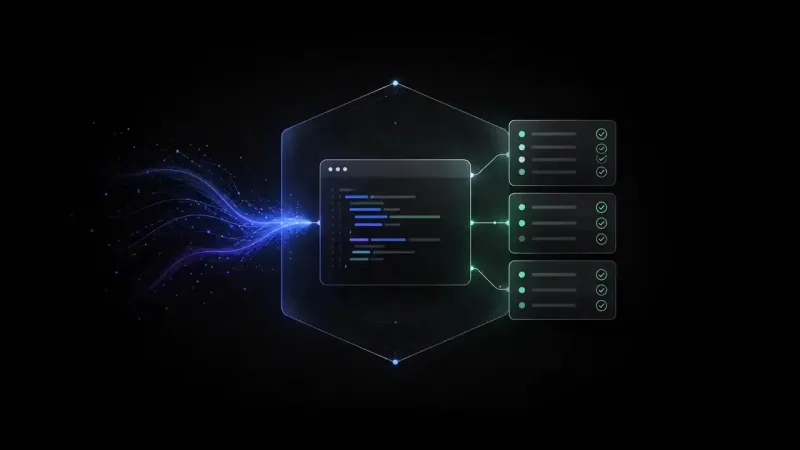
A stream of blue particles converges into a dark code editor window inside a hexagon outline, with green lines branching right to three cards of checklist rows ticked by green check marks.

AI Engineering · Aug 6, 2026 · 4 min read

The Test Suite Became Orbyt's Only Living Specification.

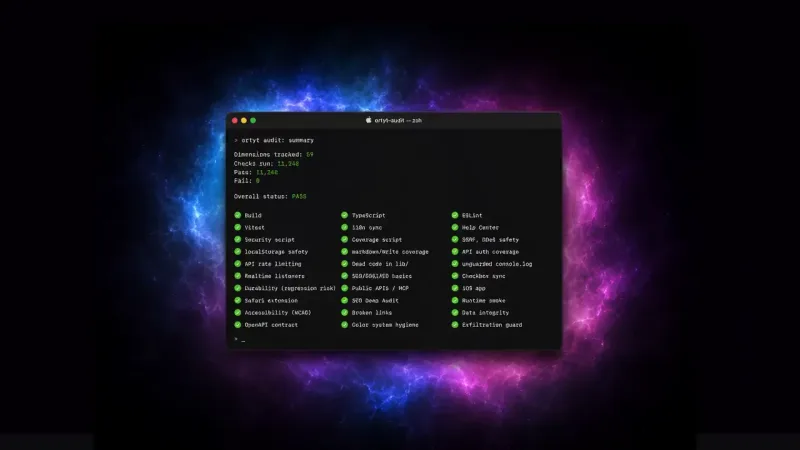
A macOS terminal window titled "ortyt-audit -- zsh" over a blue and magenta nebula reads "Dimensions tracked: 59", "Checks run: 11,248", "Pass: 11,248", "Fail: 0", "Overall status: PASS", above three columns of green ticks.

AI Engineering · Jul 9, 2026 · 7 min read

Verification Is the New Literacy

On black, blue and violet particle streams flow from translucent interface panels into a glowing layered cube, then out to a chart panel.

AI Engineering · Sep 17, 2026 · 4 min read

Context Is the New Codebase.

Blog

  • Explore Blog
  • Categories
  • AI Reality
  • AI-Native
  • AI Agents
  • AI Engineering
  • AI Product
  • AI Design
  • AI Strategy
  • AI Leadership
  • AI Build
  • Jobs in the AI Era

Get started

  • Sign Up
  • Sign In

More from Orbyt

  • Orbyt Jobs
  • Orbyt Intelligence
  • Orbyt One

Keep Exploring

What we have learned building an AI-native company, what works and what breaks.

Products

  • Orbyt Jobs
  • Orbyt Intelligence
  • Orbyt One
  • Orbyt Consulting

Research

  • Orbyt Collective

Developers

  • Orbyt API & MCP
  • Jobs API
  • Intelligence API

Publishing

  • Books
  • Blog
  • Papers

Help

  • Support
  • Contact
  • Status

Company

  • Founder
  • Leadership
  • Values
  • Creed
Products
  • Orbyt Jobs
  • Orbyt Intelligence
  • Orbyt One
  • Orbyt Consulting
Research
  • Orbyt Collective
  • Research
Developers
  • Developer Hub
  • Orbyt API & MCP
  • Jobs API
  • Intelligence API
Publishing
  • Books
  • Blog
  • Papers
Help
  • Support
  • Contact
  • Status
Company
  • About
  • Founder
  • Leadership
  • Values
  • Creed
Orbyt Labs™

© 2026 Purecraft LLC  All rights reserved.

Privacy·Terms·Security·Trademark·Accessibility·DPA·Refund·Status·Sitemap

Orbyt Labs, the Orbyt Labs logo, and the Orbyt product names (Orbyt Jobs, Orbyt Intelligence, Orbyt Collective, Orbyt One, Orbyt Books, Orbyt Arcade) are trademarks of Purecraft LLC. Product names, logos, and brands of others are the property of their respective owners. Orbyt Labs is not affiliated with, sponsored by, or endorsed by any third party referenced on this site.