Why I Switched My Design Work to AI
I moved every part of my design work into AI and code, and I am not going back. No mockups. No handoff. No translation layer between the thing I design and the thing that ships. That is the personal decision. This is the part that should be useful to you: what I learned about using AI for design that any design leader can apply, whether or not you ever burn your tools the way I did.
I did not lose my craft. I lost the parts of the job that were never the craft.
I spent fifteen years on a workflow I quietly resented. Discover, wireframe, mock, prototype, review, spec, hand off. The decision to leave it was overdue. But "I left my tools" is a story, not a method. The method is knowing where AI actually earns its place in design and where it quietly fails you. That is what most takes skip, so that is what this is.
What actually changed when I switched
The work got more honest. For most of my career, the thing I designed and the thing that shipped were two different objects joined by a hopeful document.
I would design a screen at full fidelity, hand it to engineering, then watch it land in production slightly wrong. Padding off. A weight changed. A motion curve flattened. None of it malicious. All of it interpretation loss. I spent years filing tickets against my own intent.
Now there is one object. The design is the build. When I want the spacing tighter, it is tight in production, not in a file production will approximate later.
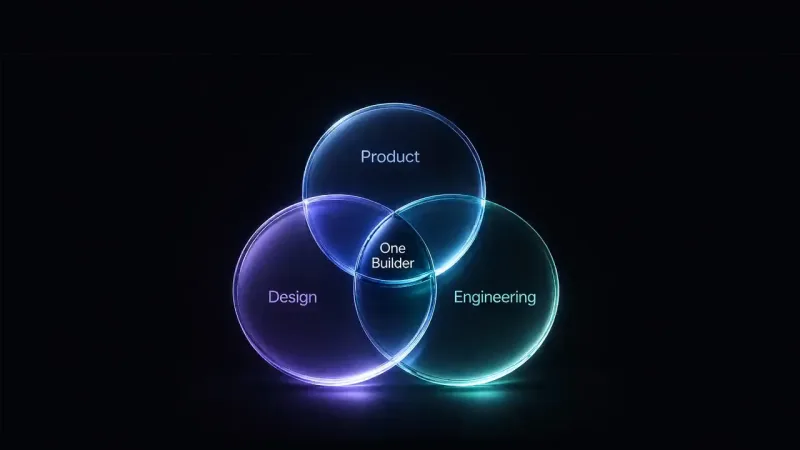
That is the emotional payoff. The durable lesson is what it taught me about the tool itself. AI did not replace my judgment. It removed the lag between my judgment and the screen. Everything good that followed came from understanding that distinction, and everything that goes wrong with AI in design comes from missing it.
Where AI genuinely helps across the design process
Use AI as an instrument with specific roles, not as an author. There are five places it consistently pays for itself.
Exploration is the first. Ask for twenty directions and you get twenty in the time one used to take. No single output is the prize. The volume is. It lets you find the edge of the problem faster, then throw most of it away.
Design systems are the second. AI is exceptional at the consistency work that bored every designer alive. Token audits. Naming. Variant coverage. The tedious enforcement that keeps a system honest. Let it do the maintenance. Spend your attention on what the system should mean, not on policing whether someone used the wrong gray.
Design in code is the third, and the largest. I describe a component in Claude Code and see it built in the real stack, against real data, at the real type scale. I react. My reaction becomes the next version in seconds. Critique and implementation collapse into one act. This is where the leverage compounds, because you are no longer designing a picture of the thing. You are designing the thing.
Iteration speed is the fourth, and it is a consequence of the third. The loop stops being design, wait, review, wait. It becomes conversation. You hold a point of view, see it rendered, and refine it while you still remember why you wanted it.
Critique is the fifth, and the most underrated. AI is a tireless first reviewer. It flags contrast failures, inconsistent spacing, and obvious accessibility gaps before a human opens the file. It catches the mechanical mistakes so your people can argue about the things that actually matter, like whether the screen earns the user's attention at all. That distinction between mechanics and meaning is the same one that separates UI from nothing. The two were always one mission, and AI is good at the mechanics half and useless at the other.
AI buys you reach and speed. It does not buy you a point of view.
The honest read on adoption
The industry signal is a gap, not a takeover. The pattern across the credible surveys is consistent: a large majority of designers report that AI makes them faster, while a much smaller share say they trust its output enough to ship unedited. Treat the exact percentages as moving targets, but the shape is stable and it is the whole argument.
Efficiency arrives first. Trust arrives late, if at all, and only through human judgment. The faster AI makes you, the more your value migrates from producing the work to deciding whether the work is right.
There is a second split worth naming. Designers mostly point AI at peripheral and asset work. Engineers already aim it at core execution, generating real code. The frontier for design is obvious: move into execution, the place builders already let AI all the way in. That migration, AI replacing the design tool outright, is the tooling thesis. I made that case bluntly in The Rise of Claude Code. The Death of Figma. I am not re-arguing it here. This piece is the practice, not the obituary. You can adopt every method below and still keep Figma open. The judgment is what transfers, not the tool you load it into.
What AI still cannot do for a designer
It cannot want anything. That is the root of every limitation downstream.
It cannot supply taste. AI hands you a confident, polished, wrong answer at full speed, and the polish is the trap. A bad idea rendered beautifully is more dangerous than a bad idea rendered badly, because it survives the room. The model has no sense of which of its twenty options is right for this product, this audience, this moment. It optimizes for plausible. Plausible is not good.
It cannot do the uphill work. Left alone, AI takes the shortest, most efficient route to something that looks finished. Original design rarely lives on the shortest route. It lives in the deliberately inefficient move, the choice no optimization function would ever make, the restraint that costs you the impressive demo and buys you the coherent product. That climb is human. Hand AI the downhill work, the variations and cleanups and first drafts, and keep the uphill climb for yourself.
It cannot decide what is worth building. This is the deepest gap. When execution becomes cheap and infinite, the scarce skill is choosing. Framing the problem. Deciding what good means before any system acts. Knowing the difference between done and loved. The best AI products feel inevitable precisely because someone exercised that judgment, and you never notice the decisions that were made on your behalf.
Taste is the new bottleneck. When the machine can build anything, knowing what to build is the entire job.
How to keep human judgment in the loop
Set intent before you generate. Output quality is downstream of how sharply you framed the ask. Vague intent in, plausible mediocrity out. The framing is the design work now, and it is harder than dragging rectangles ever was.
Evaluate ruthlessly. Reach is free, so your role shifts from production to selection. Run everything against a real standard. I put every Orbyt change through a thirty-five dimension audit before it ships, because the reviewer matters more than the generator when the generator never tires and never doubts itself.
Keep the uphill work yours. Give AI the drudgery. Never give it the risky idea, the point of view, or the call on what to delete. AI is a brilliant maximalist. Restraint does not come standard.
Protect the editorial nerve. The willingness to say no, to leave the white space, to resist the obvious move the model loves. That nerve is the thing clients and users actually feel, and it is the thing that builds trust faster than any feature. None of it survives if you let the model lead.
What this means if you lead a design org
Reorganize around taste, not tooling. The org chart you inherited assumed building was slow. That assumption is dead, and most design roles were defined by it.
Stop measuring designers by mock output. Mocks were always a proxy for shipped quality, and the proxy is obsolete. Measure point of view, judgment, and the ability to carry a decision all the way to production.
This is not a job-death story. The serious economic work on generative AI does not project value by deleting human effort. It projects it by shifting where human effort goes. Design is the same. The mechanical work evaporates. The judgment work expands to fill the room.
I have lived both sides. We took Taxa from prototype to production in five months with a team of four and helped unlock $113M in funding. I built Orbyt solo in 32 days, the first product out of Purecraft, with no mockups, no handoff, and no design system to maintain. The constant across both was never the tool. It was the standard.
Design leadership stops being about controlling a process and starts being about defending a standard.
The honest caveat
This works because I already know what good looks like. The workflow rewards taste and punishes its absence. If you need a tool to tell you what good is, removing the tool will not fix that, and AI will gladly fill the silence with confident, polished, wrong.
I am also describing a senior practitioner working close to the product. A large team with deep cross-functional dependencies will move differently. I am not pretending my path is universal. I am telling you the method underneath it is.
Use AI for the reach. Keep the taste, the point of view, and the nerve to say no.
Models and tools pass through. Taste, point of view, and judgment are the only things I ever actually owned.
Related reading:
- The Rise of Claude Code. The Death of Figma.
- Zero to One Is a Taste Game
- Building AI-Native Apps With Taste
Originally published on justinbartak.ai on Jun 18, 2026.
Common questions
Where does AI actually help in the design process?
AI helps most in five places. Exploration, generating many directions fast. Design systems, automating token audits and consistency work. Design in code, building components in the real stack against real data. Iteration, turning critique into the next version in seconds. And critique itself, flagging contrast, spacing, and accessibility issues before a human ever reviews the file.
What can AI still not do for a designer?
It cannot supply taste, hold a point of view, or decide what is worth building. Left alone, AI takes the shortest route to something that looks finished, which is rarely where original design lives. It also produces confident, polished, wrong answers at full speed, so a human must frame intent, do the uphill thinking, and decide what is actually good.
How do you keep human judgment in the loop when using AI for design?
Set sharp intent before you generate, because output quality is downstream of framing. Evaluate every result against a real standard rather than accepting the first polished option. Keep the uphill creative work and the editorial calls, what to delete and where to stop, for yourself. Hand AI the drudgery and never the point of view. Read the full article
Follow the work.
I write these while the Machine runs. Get the next one wherever you already read.