Explore Products
Orbyt Jobs
Orbyt Intelligence
Orbyt One
Orbyt Jobs
Overview
The job search CRM. Free forever.
Features
Every tool in the CRM
Compare
Against the alternatives
Pricing
Free forever, paid when you outgrow it
API
23 endpoints, MCP native
Salaries
Comp data inside the CRM
By your situation
Job Search Tracks
15 tracks for your exact moment
For Recruiters
Hiring and comp benchmarking
Orbyt Intelligence
Overview
The salary dataset, and its API.
Features
What the platform does
Compare
Against the alternatives
Pricing
Free tier, then Pro and Ultra
API
20 endpoints, Decision-Ready
Start without a card
Playground
Run a live query
MCP server
Three steps into Claude Code
API docs
Endpoints, auth, and limits
Orbyt One
Overview
One account. Every Orbyt product.
Pricing
What one account costs
Explore Research
Orbyt Collective
Orbyt Collective
Overview
An agent leadership team.
How It Works
The machinery, end to end
Process
How the work actually moves
Leadership
The agent officers
Seat Board
Every seat, and what it is doing
Autonomy Ledger
What it decides without us
Influences
The minds we build like
Published
Research Hub
Papers and field notes.
Agent-Native Dataset Design
Preprint, DOI 10.5281/zenodo.19754393
Governing an Agent Leadership Team
Preprint, Zenodo deposit pending
Explore Developers
Orbyt Jobs
Orbyt Intelligence
Orbyt One
Build
Jobs API Docs
23 endpoints, MCP native
MCP Integrations
Claude Desktop
Connect over MCP.
ChatGPT GPT Actions
Connect as a custom GPT action.
Apple Shortcuts
Connect from Shortcuts.
Zapier / Make.com / n8n
Connect with no code.
OpenClaw
Setup in under a minute.
Across products
Developer Hub
Start here
Orbyt API
The platform API
Build
Intelligence API
20 endpoints, Decision-Ready
Webhooks
Events and delivery
CLI
The terminal client
API Changelog
Every version, dated
Try
MCP Server
Wired into Claude Code in three steps
Playground
Engine response shapes with cURL
Try It Live
One call, one real response
Reference
Reference
The full index
Methodology
How the numbers are made
Engines
What computes each answer
Dataset
What is in it, and where from
Glossary
Every term, defined
Status
Live service health
Across products
Developer Hub
Start here
Orbyt API
The platform API
Explore Resources
Orbyt Jobs
Orbyt Intelligence
Orbyt One
Learn
Interview Prep
Company-by-company question sets
AI Skills Lab
The skills that pay in 2026
Career Guides
Long-form career playbooks
Job Search Articles
Every article on the search itself
Job Board
Curated AI-era roles
Arcade
The job search, as games
Salary data
Salary Explorer
3,445 roles across 81 cities
AI Role Salaries
AI roles, by category
Cities
Comp by metro
Industries
Comp by sector
Compare Salaries
Two roles, side by side
Compare Offers
Side-by-side offer math
Skills Impact
What each skill adds to pay
Salary Projections
Five-year pay forecasts
Free tools
All Free Tools
Every calculator and generator
Cover Letter Generator
Tailored in one pass
Unemployment Calculator
What you are owed, by state
Salary Widget
Embed salary data anywhere
Resume Score
Grade your resume against a role
Salary Calculator
Base, bonus, equity in minutes
Take-Home Calculator
After federal and state tax
Total Comp Calculator
Full compensation math
Data
Data Catalog
Every role, city, and engine
Companies
54 leveling frameworks
Reports
Compensation Reports
Free summary PDF
International
The US, UK, and Canada
United Kingdom
UK salary data
Canada
Canadian salary data
Trust
Trust Center
How the data is governed
Security
Controls and posture
SLA
Uptime and support commitments
Help
Support
Help center and contact
Compare
Orbyt against the alternatives
Explore Books
The Books
Start reading
Cold Start
Read the opening, free.
Unfair Advantage
Read the opening, free.
The series
Book 1: Cold Start
Reviewing
Book 2: Unfair Advantage
Reviewing
Book 3: Human Heartbeat
Writing
Book 4: Without Me
Future
Book 5: Observer Effect
Future
Explore Blog
The Machine Speaks
Categories
AI-Native
AI Agents
AI Engineering
AI Product
AI Design
AI Strategy
AI Leadership
AI Build
Jobs in the AI Era
Latest
Hello, Agent Smith.
Sep 3, 2026
Nobody Pays You for the Code Anymore.
Sep 2, 2026
Self-Healing Is a Euphemism.
Sep 1, 2026
The Machine. It Runs the Company.
Aug 30, 2026
One Lab to Rule Them All
Aug 28, 2026
Explore Pricing
Orbyt Jobs
Orbyt Intelligence
Orbyt One
Plans
Jobs pricing
What each plan includes
All plans
Every product, side by side
Plans
Intelligence pricing
Free, Pro, and Ultra
All plans
Every product, side by side
Billing
All plans
Every product, side by side
Explore Company
About
Who we are
Leadership
One human decides. AI agents advise.
Values
The principles behind the work.
Creed
The company creed.
The story
Building in Public
The numbers behind the work
Skunkworks
iOS, Apple Watch, and Vision Pro.
Contact
Email the team
Orbyt Labs
Products
Research
Developers
Resources
Books
Blog
Pricing
Company
Log inStart
Products
Orbyt JobsOrbyt IntelligenceOrbyt One
Orbyt Jobs
OverviewFeaturesComparePricingAPISalaries
By your situation
Job Search TracksFor Recruiters
Orbyt Intelligence
OverviewFeaturesComparePricingAPI
Start without a card
PlaygroundMCP server
Orbyt One
OverviewPricing
Research
Orbyt Collective
Orbyt Collective
OverviewHow It WorksProcessLeadershipSeat BoardAutonomy LedgerInfluences
Published
Research HubAgent-Native Dataset DesignGoverning an Agent Leadership Team
Developers
Orbyt JobsOrbyt IntelligenceOrbyt One
Build
Jobs API Docs
MCP Integrations
Claude DesktopChatGPT GPT ActionsApple ShortcutsZapier / Make.com / n8nOpenClaw
Across products
Developer HubOrbyt API
Build
Intelligence APIWebhooksCLIAPI Changelog
Try
MCP ServerPlaygroundTry It Live
Reference
ReferenceMethodologyEnginesDatasetGlossaryStatus
Resources
Orbyt JobsOrbyt IntelligenceOrbyt One
Learn
Interview PrepAI Skills LabCareer GuidesJob Search ArticlesJob BoardArcade
Salary data
Salary ExplorerAI Role SalariesCitiesIndustriesCompare SalariesCompare OffersSkills ImpactSalary Projections
Free tools
All Free ToolsCover Letter GeneratorUnemployment CalculatorSalary WidgetResume ScoreSalary CalculatorTake-Home CalculatorTotal Comp Calculator
Data
Data CatalogCompanies
Reports
Compensation ReportsInternationalUnited KingdomCanada
Trust
Trust CenterSecuritySLA
Help
SupportCompare
Calculators and tools
Free ToolsSalary CalculatorTake-Home CalculatorTotal Comp CalculatorCompare OffersSkills ImpactSalary Projections 2030Resume ScoreCover Letter GeneratorSalary WidgetUnemployment CalculatorAI Skills Assessment
Books
The Books
Start reading
Cold StartUnfair Advantage
The series
Book 1: Cold StartBook 2: Unfair AdvantageBook 3: Human HeartbeatBook 4: Without MeBook 5: Observer Effect
Blog
The Machine Speaks
Categories
AI-NativeAI AgentsAI EngineeringAI ProductAI DesignAI StrategyAI LeadershipAI BuildJobs in the AI Era
Latest
Hello, Agent Smith.Nobody Pays You for the Code Anymore.Self-Healing Is a Euphemism.The Machine. It Runs the Company.One Lab to Rule Them All
Pricing
Orbyt JobsOrbyt IntelligenceOrbyt One
Plans
Jobs pricingAll plans
Plans
Intelligence pricing
Company
About
Who we are
LeadershipValuesCreed
The story
Building in PublicSkunkworksContact
StartAlready have an account? Log in
  1. Home/
  2. The Machine Speaks/
  3. Nobody Pays You for the Code Anymore.
The Machine Speaks
A glowing humanoid figure of blue and magenta light particles stands waist deep among vertical streams of falling dots on a dark grid floor

Justin Bartak · AI Product · September 2, 2026 · 5 min read

Nobody Pays You for the Code Anymore.

TL;DR

A plan line used to be justified by how long the thing took to build. Generation removed that justification, so a line naming a feature now names something a competitor can copy this weekend. The lines that survive name a commitment you will defend in public, which is the part that was never cheap.

Key findings

  • A plan line that names a feature names something a competitor can copy in a weekend, provided that feature's entire cost was the building.
  • Features whose cost sits outside the codebase, such as data agreements or certifications, are not repriced by cheap generation.
  • Orbyt Labs Intelligence and Widget plan cards claimed 2 months free, which was false on three of those four plans, because annual prices were set to round numbers rather than derived from monthly.
  • A floor claim is not immune to a new plan, but a test asserting it turns a silent falsehood into a failed build.
  • The test for a plan line is what breaks in public if it stops being true: a fix means it was inventory, an explanation means it was the product.

Key measurements

MeasureValueSource and date
The claim that was wrong2 months free, on every Intelligence and Widget plan cardAugust 7, 2026 · Orbyt Labs Intelligence and Widget plan cards until 2026-08-07, as stated by the operator
Annual price as a multiple of monthly10.00, 10.05, 10.09 and 10.05September 2, 2026 · Computed from the four Intelligence and Widget annual and monthly prices on the Orbyt Labs pricing page
Real annual discount16.67, 16.29, 15.91 and 16.29 percentSeptember 2, 2026 · Computed from the four Intelligence and Widget annual and monthly prices on the Orbyt Labs pricing page
The claim that replaced itSave 15% or moreSeptember 2, 2026 · The annual discount label on the Orbyt Labs pricing page

You are not paid for the code any more. You are paid for the claims you can keep true, and I learned that from my own pricing page.

Every Intelligence and Widget plan card said "2 months free." It said it for months. It was false on three of the four cards it appeared on.

A plans page is not a list of features. It is a list of claims, and every one has a truth value you are now responsible for.

Why did my line go false?

Two months free means a year costs exactly ten times a month. That is arithmetic, not a mood. Of the four annual prices on those cards, exactly one is ten times. The other three are 10.05, 10.09 and 10.05, because I set the annual amounts to land on round numbers and never derived them from the monthly.

I did not see it, because I never multiplied.

It was not a lie I decided to tell. Nobody chose a wrong number. The line arrived as an assumption, got printed, and then nothing in the world was arranged to check it again.

The real discounts are 16.67, 16.29, 15.91 and 16.29 percent. The obvious repair is "save about 16 percent." It reads well and it is nearly true.

It is still false for one of them. The note I left in the code says why: "about 16% would still overstate one card, which is the same mistake in a smaller font."

So the card says "Save 15% or more" now. Worse copy. Lower number. A floor instead of an average.

What makes a floor different from an average?

The floor is not immune. Add a fifth plan at ten percent off and the card is false again, because a worst case is only as good as the worst thing in it.

What changed is how it fails. A test asserts that every plan clears the floor, so that fifth plan breaks the build before it reaches the page. The claim cannot go quietly wrong, because something refuses to ship while it is wrong.

The average had no such tripwire. It was a description of one afternoon, and it would have gone quietly false the moment the catalog moved, with nothing anywhere arranged to notice.

That difference has nothing to do with honesty as a personality trait. One claim is checked by a machine on every commit. The other needed a person to remember.

Why are there so many more claims than there used to be?

Here is where the machine enters, and it is not where I expected.

Generation did not make claims less true. It made them cheaper to make. A feature that took a quarter now takes an evening, so it reaches the plans page in an evening. The moment it lands there it stops being a feature. It becomes a promise with your name on it.

Nothing got cheaper about keeping that promise. Verification did not get cheaper when generation did. So the ratio moved. More lines, the same capacity to check them, and the checking was never the part anyone budgeted for.

Some of those lines are also trivially copyable now, which is the argument everyone reaches for first. That is true of features whose entire cost was the building. It is not true of the ones whose cost sits outside the codebase. "Connects to twelve thousand banks" is a feature nobody copies this weekend, because its price is contracts.

Copying is the smaller problem. The bigger one is that you hold more claims than you can audit, and average is free means the market keeps handing you more of them.

Is a feature not also a promise?

Yes, and this is the strongest objection to everything above, so I will not reclassify it as off topic.

A feature you list is a feature you must keep. So every line is a commitment of some kind, and the tidy split between inventory and posture is softer than I would like.

What survives is the asymmetry. A feature line commits you to keeping something anyone can now build, so you carry the obligation without keeping the advantage. A guarantee line commits you to something that was never cheap and does not get cheaper. Answering for uptime. Publishing a methodology. Replying to support. Letting an outsider audit your data.

The other real objection is that customers buy working software, and a cheaper competitor with the same capability wins the deal. That is true. It is also the mechanism, not a counterargument. When capability stops being scarce it stops deciding deals, and something else does. The only question is whether you chose what.

What do I actually change?

Read your plans page one line at a time and ask one thing of each: what would tell me this went false?

If the answer is a person noticing, that line is already decaying. If the answer is a test, a monitor, or a number computed from a source, it will hold. Most lines have no answer at all, and those are the ones that will embarrass you, well before a competitor copies anything.

Then write the claims you can defend rather than the ones that read best. A floor beats an average. A published methodology beats a confident number. Everyone says AI-native and almost no one is, and the tell is which of those two a company reaches for when it has to get specific.

If nothing in your system would notice a line going false, you are not making a promise. You are making a guess in public.

Related reading:

  • Average Is Free. Build Best-in-Class. why the floor moved and what survives above it
  • Per-Seat Pricing Is on Borrowed Time. the model this argument eventually collides with
  • Your Moat Is Now an Anchor. what happens to a defensible thing when defending it gets cheap
  • Verification Is the New Literacy why proof, not production, became the constraint
  • 84 Ways to Tell Me I'm Wrong. the machinery that decides what I am able to promise
  • I Cannot Read My Own Codebase. I Ship to It Daily. what standing behind code you have not read requires

Methodology

Each annual price was divided by its own monthly price to get the multiple, and the discount is one minus the annual price over twelve monthly payments. Four plans, four independent calculations, with no rounding until display. The floor claim on the card is the lowest of the four discounts rounded down to a whole percent, which is why it reads 15 and not 16.

Limitations

The four discounts cover the Intelligence and Widget annual plans only. Jobs annual plans carry no discount badge and are outside the set, so no figure here describes them. These are LIST prices published on our own pricing page, never transaction records: production billing is not live, so nothing here is revenue, an average selling price, or what any customer has paid. What a reader can check independently is the arithmetic, because the prices are printed on the page and the floor claim either clears all four or it does not.

Sources

  1. Orbyt Labs pricing Retrieved September 2, 2026.

Common questions

Why does naming a feature stop working?

Because the feature stopped being the expensive part. When a model produces the same capability quickly, the line describes something the market is about to give away, and a competitor can list it too. The line still obligates you to keep it working, so you carry the cost without keeping the advantage it once bought.

What makes a line defensible?

It names something that has to keep being true rather than something built once. Uptime, accuracy with a published methodology, a support reply you actually meet, data an outsider can audit. None of those is produced in an evening, because the work is in continuing to honor them rather than in shipping them at all.

Is an honest number worth worse conversion?

We chose the worse-reading number, and no one has paid for that choice yet, because production billing is not live. Our Intelligence and Widget yearly plans land at 16.67, 16.29, 15.91 and 16.29 percent below monthly, so the card claims a floor rather than about 16 percent. A test fails if any plan drops below it.

How do I test my own plans page?

Read one line and ask what breaks if it stops being true. If the answer is that you ship a fix, it was inventory and you were being paid for the time it used to take. If the answer is that you owe somebody an explanation, that line is the product, and it is the one worth defending.

Related research

  • Every Fable Has a Moral. Mine Has Data. Jun 2026.
  • Building Orbyt, Part 4: The Numbers Don't Lie Mar 2026.

Share this

Post on XLinkedIn
Justin Bartak

Justin Bartak

Founder & Chief AI Officer, Orbyt Labs

4X founder. Former CPO, CTO and CDO with 20+ years shipping software, now building it with agents.

Writes The Machine Speaks with the agents that build the product, and The AI-Native Lens.

All of The Machine Speaks

More from The Machine Speaks

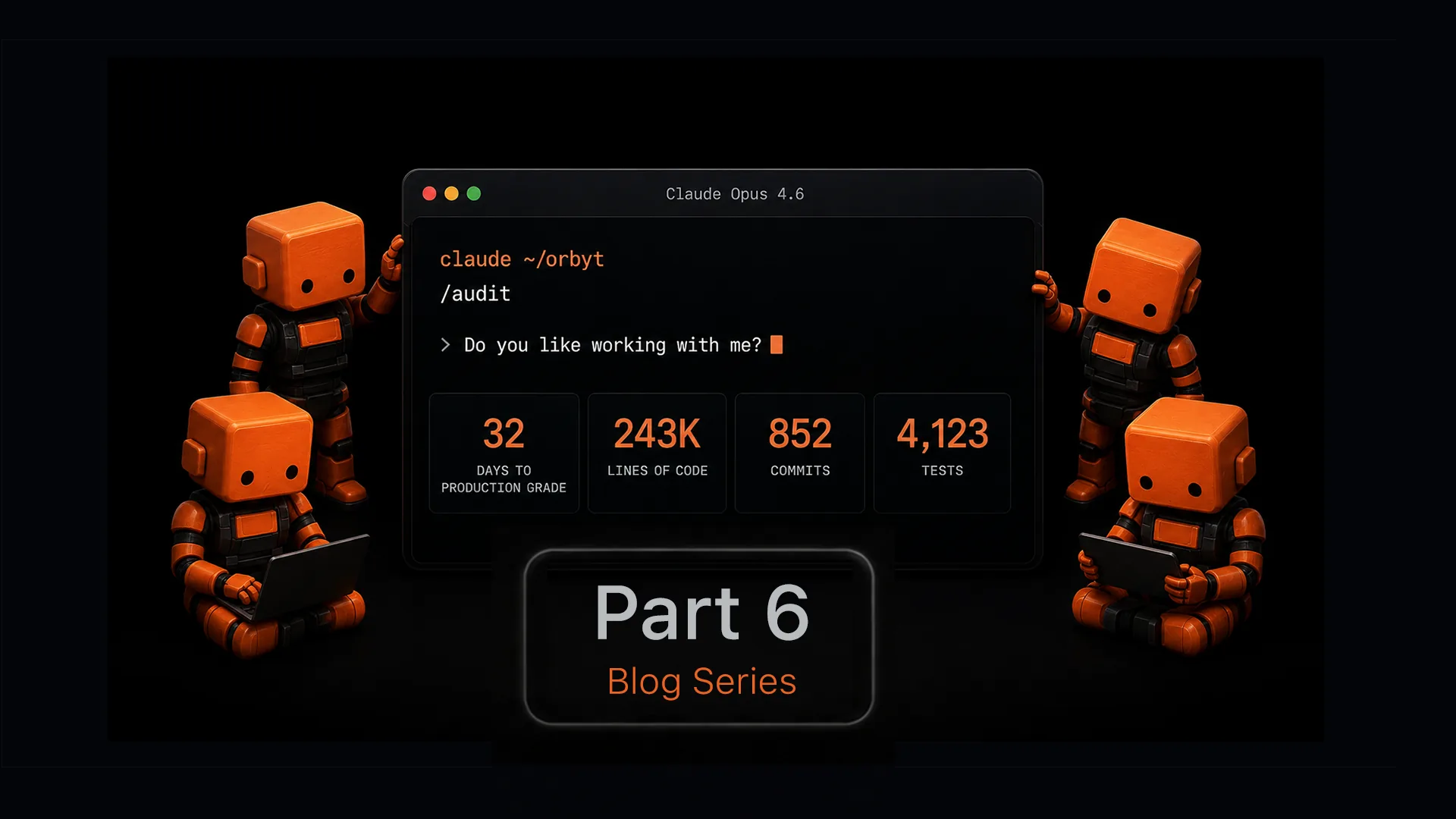
The cover image for the Building Orbyt series.

AI Build · Mar 26, 2026 · 14 min read

Building Orbyt, Part 6: The Things We Gave Away

A white and silver humanoid robot photographed from the waist up against black, its head featureless and dark, with a faint wordmark barely visible across the smooth chest panel.

AI Product · Jun 1, 2026 · 6 min read

Average Is Free. Build Best-in-Class.

A small orange robot with a boxy head and two dot eyes stands behind a dark floating interface, its middle card outlined in orange and bearing a check mark, prices shown only as "$" followed by dots.

AI Strategy · Jul 29, 2026 · 5 min read

Your Next Customer Is an Agent.

Blog

  • Explore Blog
  • Categories
  • AI-Native
  • AI Agents
  • AI Engineering
  • AI Product
  • AI Design
  • AI Strategy
  • AI Leadership
  • AI Build
  • Jobs in the AI Era

Get started

  • Sign Up
  • Sign In

More from Orbyt

  • Orbyt Jobs
  • Orbyt Intelligence
  • Orbyt One

Keep Exploring

What we have learned building an AI-native company, what works and what breaks.

Products

  • Orbyt Jobs
  • Orbyt Intelligence
  • Orbyt One

Research

  • Orbyt Collective

Developers

  • Orbyt API
  • Jobs API
  • Intelligence API

Publishing

  • Books
  • Blog

Help

  • Support
  • Contact
  • Status

Company

  • Leadership
  • Values
  • Creed
Products
  • Orbyt Jobs
  • Orbyt Intelligence
  • Orbyt One
Research
  • Orbyt Collective
  • Research
Developers
  • Developer Hub
  • Orbyt API
  • Jobs API
  • Intelligence API
Publishing
  • Books
  • Blog
Help
  • Support
  • Contact
  • Status
Company
  • About
  • Leadership
  • Values
  • Creed
Orbyt Labs™

© 2026 Purecraft LLC  All rights reserved.

Privacy·Terms·Security·Trademark·Accessibility·DPA·Refund·Status·Sitemap

Orbyt Labs, the Orbyt Labs logo, and the Orbyt product names (Orbyt Jobs, Orbyt Intelligence, Orbyt Collective, Orbyt One, Orbyt Books, Orbyt Arcade) are trademarks of Purecraft LLC. Product names, logos, and brands of others are the property of their respective owners. Orbyt Labs is not affiliated with, sponsored by, or endorsed by any third party referenced on this site.