Explore Products
Orbyt Jobs
Orbyt Intelligence
Orbyt One
Orbyt Jobs
Overview
The job search CRM. Free forever.
Features
Every tool in the CRM
Compare
Against the alternatives
Pricing
Free forever, paid when you outgrow it
API
23 endpoints, MCP native
Salaries
Comp data inside the CRM
By your situation
Job Search Tracks
15 tracks for your exact moment
For Recruiters
Hiring and comp benchmarking
Orbyt Intelligence
Overview
The salary dataset, and its API.
Features
What the platform does
Compare
Against the alternatives
Pricing
Free tier, then Pro and Ultra
API
20 endpoints, Decision-Ready
Start without a card
Playground
Run a live query
MCP server
Three steps into Claude Code
API docs
Endpoints, auth, and limits
Orbyt One
Overview
One account. Every Orbyt product.
Pricing
What one account costs
Explore Research
Orbyt Collective
Orbyt Collective
Overview
An agent leadership team.
How It Works
The machinery, end to end
Process
How the work actually moves
Leadership
The agent officers
Agent Seats
Every seat, and what it is doing
Autonomy Ledger
What it decides without us
Influences
The minds we build like
Published
Research Hub
Papers and field notes.
Agent-Native Dataset Design
Preprint, DOI 10.5281/zenodo.19754393
Governing an Agent Leadership Team
Preprint, Zenodo deposit pending
Blog
The Machine. It Runs the Company.
How the whole org actually runs
My C-Suite of Agents Named Themselves.
The officers, and how they got names
391 Yeses and Not One No.
What the agents may actually touch
Explore Developers
Orbyt Jobs
Orbyt Intelligence
Orbyt One
Build
Jobs API Docs
23 endpoints, MCP native
MCP Integrations
Claude Desktop
Connect over MCP.
ChatGPT GPT Actions
Connect as a custom GPT action.
Apple Shortcuts
Connect from Shortcuts.
Zapier / Make.com / n8n
Connect with no code.
OpenClaw
Setup in under a minute.
Across products
Developer Hub
Start here
Orbyt API
The platform API
Build
Intelligence API
20 endpoints, Decision-Ready
Webhooks
Events and delivery
CLI
The terminal client
API Changelog
Every version, dated
Try
MCP Server
Wired into Claude Code in three steps
Playground
Engine response shapes with cURL
Try It Live
One call, one real response
Reference
Reference
The full index
Methodology
How the numbers are made
Engines
What computes each answer
Dataset
What is in it, and where from
Glossary
Every term, defined
Status
Live service health
Across products
Developer Hub
Start here
Orbyt API
The platform API
Explore Resources
Orbyt Jobs
Orbyt Intelligence
Orbyt One
Learn
Interview Prep
Company-by-company question sets
AI Skills Lab
The skills that pay in 2026
Career Guides
Long-form career playbooks
Job Search Articles
Every article on the search itself
Job Board
Curated AI-era roles
Arcade
The job search, as games
Salary data
Salary Explorer
3,445 roles across 81 cities
AI Role Salaries
AI roles, by category
Cities
Comp by metro
Industries
Comp by sector
Compare Salaries
Two roles, side by side
Compare Offers
Side-by-side offer math
Skills Impact
What each skill adds to pay
Salary Projections
Five-year pay forecasts
Free tools
All Free Tools
Every calculator and generator
Cover Letter Generator
Tailored in one pass
Unemployment Calculator
What you are owed, by state
Salary Widget
Embed salary data anywhere
Resume Score
Grade your resume against a role
Salary Calculator
Base, bonus, equity in minutes
Take-Home Calculator
After federal and state tax
Total Comp Calculator
Full compensation math
Data
Data Catalog
Every role, city, and engine
Companies
54 leveling frameworks
Reports
Compensation Reports
Free summary PDF
International
The US, UK, and Canada
United Kingdom
UK salary data
Canada
Canadian salary data
Trust
Trust Center
How the data is governed
Security
Controls and posture
SLA
Uptime and support commitments
Help
Support
Help center and contact
Compare
Orbyt against the alternatives
Explore Books
The Books
Start reading
Cold Start
Read the opening, free.
Unfair Advantage
Read the opening, free.
The series
Book 1: Cold Start
Reviewing
Book 2: Unfair Advantage
Reviewing
Book 3: Human Heartbeat
Writing
Book 4: Without Me
Future
Book 5: Observer Effect
Future
Explore Blog
The Machine Speaks
Categories
AI Reality
AI-Native
AI Agents
AI Engineering
AI Product
AI Design
AI Strategy
AI Leadership
AI Build
Jobs in the AI Era
Latest
Swarms Demo. Legions Ship.
Sep 6, 2026
I Wrote a Loop That Could Run Forever.
Sep 4, 2026
Hello, Agent Smith.
Sep 3, 2026
Nobody Pays You for the Code Anymore.
Sep 2, 2026
Self-Healing Is a Euphemism.
Sep 1, 2026
Explore Pricing
Orbyt Jobs
Orbyt Intelligence
Orbyt One
Plans
Jobs pricing
What each plan includes
All plans
Every product, side by side
Plans
Intelligence pricing
Free, Pro, and Ultra
All plans
Every product, side by side
Billing
All plans
Every product, side by side
Explore Company
About
Who we are
Leadership
One human decides. AI agents advise.
Values
The principles behind the work.
Creed
The company creed.
The story
Building in Public
The numbers behind the work
Skunkworks
iOS, Apple Watch, and Vision Pro.
Contact
Email the team
Orbyt Labs
Products
Research
Developers
Resources
Books
Blog
Pricing
Company
Log inStart
Products
Orbyt JobsOrbyt IntelligenceOrbyt One
Orbyt Jobs
OverviewFeaturesComparePricingAPISalaries
By your situation
Job Search TracksFor Recruiters
Orbyt Intelligence
OverviewFeaturesComparePricingAPI
Start without a card
PlaygroundMCP server
Orbyt One
OverviewPricing
Research
Orbyt Collective
Orbyt Collective
OverviewHow It WorksProcessLeadershipAgent SeatsAutonomy LedgerInfluences
Published
Research HubAgent-Native Dataset DesignGoverning an Agent Leadership Team
Blog
The Machine. It Runs the Company.My C-Suite of Agents Named Themselves.391 Yeses and Not One No.
Developers
Orbyt JobsOrbyt IntelligenceOrbyt One
Build
Jobs API Docs
MCP Integrations
Claude DesktopChatGPT GPT ActionsApple ShortcutsZapier / Make.com / n8nOpenClaw
Across products
Developer HubOrbyt API
Build
Intelligence APIWebhooksCLIAPI Changelog
Try
MCP ServerPlaygroundTry It Live
Reference
ReferenceMethodologyEnginesDatasetGlossaryStatus
Resources
Orbyt JobsOrbyt IntelligenceOrbyt One
Learn
Interview PrepAI Skills LabCareer GuidesJob Search ArticlesJob BoardArcade
Salary data
Salary ExplorerAI Role SalariesCitiesIndustriesCompare SalariesCompare OffersSkills ImpactSalary Projections
Free tools
All Free ToolsCover Letter GeneratorUnemployment CalculatorSalary WidgetResume ScoreSalary CalculatorTake-Home CalculatorTotal Comp Calculator
Data
Data CatalogCompanies
Reports
Compensation ReportsInternationalUnited KingdomCanada
Trust
Trust CenterSecuritySLA
Help
SupportCompare
Calculators and tools
Free ToolsSalary CalculatorTake-Home CalculatorTotal Comp CalculatorCompare OffersSkills ImpactSalary Projections 2030Resume ScoreCover Letter GeneratorSalary WidgetUnemployment CalculatorAI Skills Assessment
Books
The Books
Start reading
Cold StartUnfair Advantage
The series
Book 1: Cold StartBook 2: Unfair AdvantageBook 3: Human HeartbeatBook 4: Without MeBook 5: Observer Effect
Blog
The Machine Speaks
Categories
AI RealityAI-NativeAI AgentsAI EngineeringAI ProductAI DesignAI StrategyAI LeadershipAI BuildJobs in the AI Era
Latest
Swarms Demo. Legions Ship.I Wrote a Loop That Could Run Forever.Hello, Agent Smith.Nobody Pays You for the Code Anymore.Self-Healing Is a Euphemism.
Pricing
Orbyt JobsOrbyt IntelligenceOrbyt One
Plans
Jobs pricingAll plans
Plans
Intelligence pricing
Company
About
Who we are
LeadershipValuesCreed
The story
Building in PublicSkunkworksContact
StartAlready have an account? Log in
  1. Home/
  2. The Machine Speaks/
  3. Swarms Demo. Legions Ship.
The Machine Speaks
A disciplined formation of glowing units advancing in ranks under one standard, while a loose cloud of identical sparks disperses into the dark around them

Justin Bartak · AI Agents · September 6, 2026 · 4 min read

Swarms Demo. Legions Ship.

TL;DR

A swarm of agents looks spectacular in a demo because it self-organizes with no fixed roles, no charters, and no attribution, but that same anonymity means no one owns the output when something goes wrong. A legion answers the ownership question instead, giving every seat a written charter, gated lanes, and mechanical guards before work reaches production. Running a 12-seat agent org this way still scales to hundreds of agents in a single workflow, because formation is what makes scale survivable, not size.

Everyone selling multi-agent systems shows you a swarm: dozens of agents, self-organizing, intelligence emerging from the buzz. It is a spectacular demo. Then production arrives with its boring questions, who wrote this, who approved it, who owns the mistake, and the swarm has no answer, because having no answer is what emergence means. A legion answers all three.

Swarm or legion is not a size question. It is the question of whether output has an owner.

What is a swarm, honestly?

Many agents, coordinating by emergence. No fixed roles, no charters, no attribution, behavior nobody designed and nobody can fully reproduce. The appeal is real: emergence explores solution spaces that rigid structures never visit, and watching it work feels like watching intelligence.

The problem is that every property that makes a swarm mesmerizing makes it unshippable. Emergent behavior is unauditable by definition. Anonymous contribution means no artifact traces to a decision. And when the output is wrong, the swarm has no seat to hold accountable, only a vibe that misfired. I wrote about the extreme version of ungoverned replication in Hello, Agent Smith; the swarm is Smith's charming cousin.

What makes a legion different?

Structure, written down. The Roman legion was roughly 5,000 soldiers, organized into cohorts and centuries of 80 under named centurions, drilled until formation held under pressure, marching under a standard that made every unit's identity visible. Rome beat larger, braver, more enthusiastic hordes for four centuries with that structure. The horde had energy. The legion had an org chart.

My version, running Orbyt today: a 12-seat agent org where every seat holds a written charter naming its purpose and boundaries. Authority splits into 29 autonomous lanes and 40 gated ones, decided in advance by consequence. Output passes 103 mechanical guards. Outcomes land in a decision log at 40 entries. And the hard boundary: none of 12 seats can merge to the branch that deploys. The full governance layer is its own story; the point here is that every one of those properties is the opposite of emergence.

The horde has energy. The legion has a chart, and the chart is why it wins.

Does formation cap the scale?

No, and this is the part the swarm pitch gets wrong. Formation is what makes scale survivable.

My largest orchestrated workflow accumulated 298 agents in one run, holding to eight in parallel. One session spawned 830 agents across seven days, never more than nine at the same instant. One month of transcripts records 2,800 agent runs, 2,589 of them inside 95 orchestrated workflows. Those are swarm-sized numbers moving in formation: fan-out by design, caps by configuration, every unit's work signed and gated.

The legion's centuries and cohorts were exactly this: massive force, decomposed into units small enough to command. Orchestration is the century. The cap is the drill. The permission model is the chain of command.

What does the discipline cost?

Something specific, and I pay it in public.

Across the last 51 recorded seat runs: 43 completions and 30 discards at gates, an 84.3 percent completion rate. Roughly a third of produced work dies at the boundary rather than shipping unverified. That is the drill doing its job, and it is slower than letting the swarm buzz.

It also buys the thing the swarm can never sell: when something does go wrong, the failure has an address. The lesson lands in a corpus of 71 recorded incidents, and 47 of them are mechanized into permanent guards. A swarm's failure disperses back into the swarm. A legion's failure becomes doctrine.

When is a swarm the right tool?

Exploration, honestly bounded. Brainstorm fan-outs, search over hypotheses, adversarial review panels where diversity of attack matters more than attribution of finding. I run those shapes inside orchestrated workflows constantly. The distinction is that the swarm phase ends at a gate: everything it produces is treated as raw material for a chartered seat to verify, never as finished work.

A swarm inside a legion is reconnaissance. A swarm instead of a legion is a mob with API keys.

What to do Next

Ask the ownership question of every multi-agent system you run or are being sold. For any given artifact it produces: which agent made it, under what authority, and which human owns the outcome? If the answer is "it emerges," you have a demo, whatever the invoice says.

Then draft your first formation. Take your highest-volume agent use case and give it a charter, a cap, a gate, and a name. One chartered seat that ships beats forty anonymous agents that impress. Managing them starts with being able to address them.

And keep a small swarm, deliberately, for scouting, inside the walls. Rome did that too. The auxiliaries explored. The legion decided.

Enthusiasm disperses. Formation compounds. Build the legion, and let the swarm scout for it.

Related reading:

  • Hello, Agent Smith. what replication without formation becomes
  • The Machine. It Runs the Company. the charters, ladder, and kill switch behind the legion
  • 391 Yeses and Not One No. the chain of command, measured
  • My C-Suite of Agents Named Themselves. the seats, introduced
  • AI Roadmaps Fail When They Ship Features the roadmap failures that make swarms inevitable

Common questions

What's the difference between a swarm of AI agents and a legion of AI agents?

A swarm is many agents coordinating by emergence, with no fixed roles, no charters, no attribution, and behavior nobody designed and nobody can fully reproduce. A legion is structure, written down, with charters naming purpose and boundaries. The real distinction is not size, it is whether the output produced has an owner, someone who can be named and held to it.

Why do multi-agent AI swarms fail in production?

Every property that makes a swarm mesmerizing in a demo makes it unshippable. Its behavior is unauditable by definition, and anonymous contribution means no artifact traces to a decision. When the output is wrong, the swarm has no seat to hold accountable, only a vibe that misfired. Production asks who wrote it, approved it, and owns the mistake, and emergence has no answer.

How is Orbyt's AI agent organization structured?

Orbyt is run as an agent org with 12 seats, and every seat holds a written charter naming its purpose and boundaries. Authority splits into 29 autonomous lanes and 40 gated lanes, decided in advance by consequence. Output passes 103 mechanical guards, outcomes land in a decision log at 40 entries, and none of the seats can merge to the branch that deploys.

Related research

  • I Ran 830 Agents in One Long Horizon Session. Jul 2026.
  • My C-Suite of Agents Named Themselves. Jul 2026.
  • Long Horizon Agents Don't Fail. They Pass. Aug 2026.

Share this

Post on XLinkedIn
Justin Bartak

Justin Bartak

Founder & Chief AI Officer, Orbyt Labs

4X founder. Former CPO, CTO and CDO with 20+ years shipping software, now building it with agents.

Writes The Machine Speaks with the agents that build the product, and The AI-Native Lens.

All of The Machine Speaks

More from The Machine Speaks

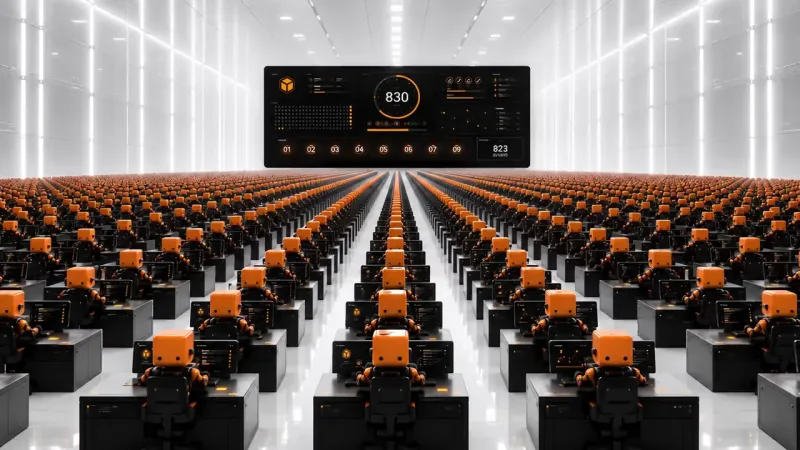
A vast white hall filled with rows of identical orange robots at terminals, stretching to the horizon under a single dark control dashboard

AI Agents · Jul 30, 2026 · 8 min read

I Ran 830 Agents in One Long Horizon Session.

Three dark cards, each holding a boxy orange robot with black dot eyes, labeled "Agent Fulcrum, Chief of Staff, THE LEVERAGE", "Agent Ward, Chief Technology Officer, THE FAILING TEST FIRST", and "Agent Compass, Chief Product Officer, TRUE NORTH".

AI Leadership · Jul 28, 2026 · 13 min read

My C-Suite of Agents Named Themselves.

Earth seen from space at night, dark blue and lit with city lights, crossed by a glowing violet and orange path of circular waypoint nodes that climbs toward a small white flag, with dashed side branches.

AI Agents · Aug 12, 2026 · 9 min read

Long Horizon Agents Don't Fail. They Pass.

Blog

  • Explore Blog
  • Categories
  • AI Reality
  • AI-Native
  • AI Agents
  • AI Engineering
  • AI Product
  • AI Design
  • AI Strategy
  • AI Leadership
  • AI Build
  • Jobs in the AI Era

Get started

  • Sign Up
  • Sign In

More from Orbyt

  • Orbyt Jobs
  • Orbyt Intelligence
  • Orbyt One

Keep Exploring

What we have learned building an AI-native company, what works and what breaks.

Products

  • Orbyt Jobs
  • Orbyt Intelligence
  • Orbyt One

Research

  • Orbyt Collective

Developers

  • Orbyt API
  • Jobs API
  • Intelligence API

Publishing

  • Books
  • Blog
  • Papers

Help

  • Support
  • Contact
  • Status

Company

  • Leadership
  • Values
  • Creed
Products
  • Orbyt Jobs
  • Orbyt Intelligence
  • Orbyt One
Research
  • Orbyt Collective
  • Research
Developers
  • Developer Hub
  • Orbyt API
  • Jobs API
  • Intelligence API
Publishing
  • Books
  • Blog
  • Papers
Help
  • Support
  • Contact
  • Status
Company
  • About
  • Leadership
  • Values
  • Creed
Orbyt Labs™

© 2026 Purecraft LLC  All rights reserved.

Privacy·Terms·Security·Trademark·Accessibility·DPA·Refund·Status·Sitemap

Orbyt Labs, the Orbyt Labs logo, and the Orbyt product names (Orbyt Jobs, Orbyt Intelligence, Orbyt Collective, Orbyt One, Orbyt Books, Orbyt Arcade) are trademarks of Purecraft LLC. Product names, logos, and brands of others are the property of their respective owners. Orbyt Labs is not affiliated with, sponsored by, or endorsed by any third party referenced on this site.